



Manchester, UK,
08
September
2026
|
13:34
Europe/London
New molecular magnet design boosts magnetic memory performance
By combining the most successful features of previous molecular magnet designs, researchers have created high-performing lanthanide-based molecules that could support future ultra-high-density data storage technologies.
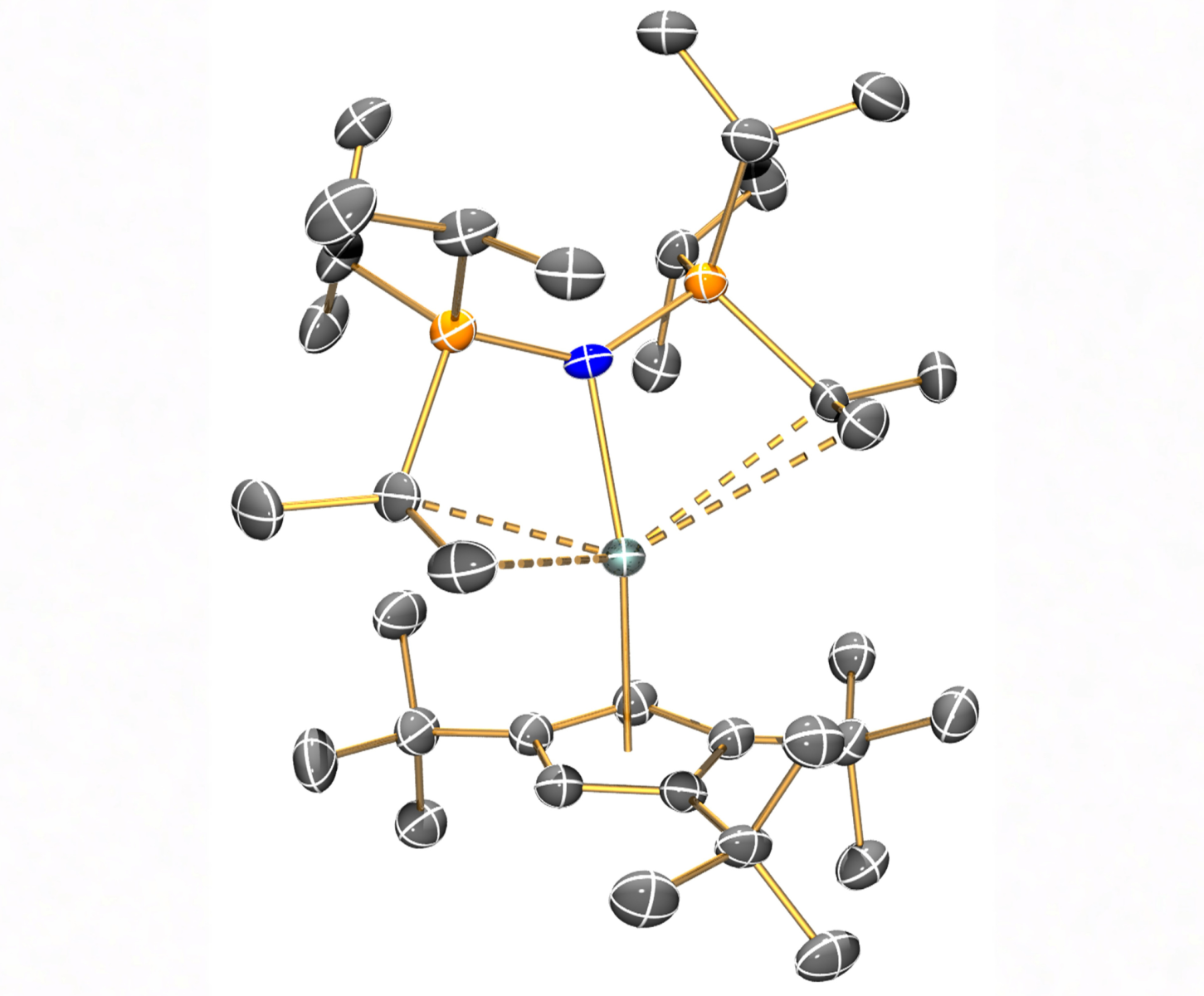
Structure of a dysprosium cyclopentadienyl-amide compound determined by single crystal X-ray diffraction. Counterion and hydrogen atoms not shown. Key - Dysprosium Cyan, Nitrogen Blue, Silicon Orange, Carbon Grey.
Researchers at The University of Manchester and the Australian National University have developed a new class of molecular magnets that combines the most successful features of previous designs, resulting in some of the strongest magnetic memory properties reported to date.
The work, published in Nature Communications, centres on single-molecule magnets (SMMs), a class of materials capable of storing magnetic information within individual molecules. These materials are being explored as candidates for future ultra-high-density data storage technologies, as they offer the potential for information to be stored on a dramatically smaller scale than in conventional magnetic devices.
Controlling the geometry of lanthanide compounds has long been one of the major challenges in molecular magnet design. The researchers have overcome part of that challenge by combining two molecular architectures that had previously delivered strong, but different, magnetic properties.
“
"The best single-molecule magnets reported over the past decade have tended to excel in different areas. Our goal was to bring the most successful features of these designs together in a single molecule. By carefully controlling the structure around the dysprosium centre, we've produced materials that perform strongly across several key measures of magnetic memory."
Professor David Mills, Professor of Inorganic Chemistry, The University of Manchester
„

The international team, led by Professor David Mills at Manchester and Professor Nicholas Chilton at the Australian National University, combined cyclopentadienyl ligands, which help create rigid molecular structures, with amide ligands, which form particularly short dysprosium-nitrogen bonds. The resulting molecules adopted near-linear structures with ligand angles approaching 172°, a geometry believed to contribute in part to their exceptional magnetic behaviour.
Alongside magnetic hysteresis temperatures of up to 92 K, the new materials were able to store magnetic information for a hundred seconds up to a temperature of 40 K, indicating significantly improved retention of magnetic memory compared with earlier dysprosium-amide systems.
Professor David Mills continued: “Controlling the geometries of lanthanide compounds is notoriously difficult as the chemical bonding is non-directional. Therefore, although near-linear dysprosium compounds have long been predicted to give the best SMMs, we are only now able to use carefully selected combinations of ligands to consistently deliver these target molecules.”
The ability to create SMMs with magnetic memory effects at higher temperatures widens the opportunity for these molecules to be used for high-density data storage devices, which is important for the ever-increasing amount of data storage required in for our technological age.
This research was published in: Nature Communications
Full title of the paper: Axial dysprosium cyclopentadienyl-amide single-molecule magnets with hysteresis up to 92 kelvin
DOI: 10.1038/s41467-026-77104-z
References to selected previous papers from these research groups can be found below:
Soft magnetic hysteresis in a dysprosium amide-alkene complex up to 100 Kelvin, Nature. https://doi.org/10.1038/s41586-025-09138-0
Molecular magnetic hysteresis at 60 K in dysprosocenium, Nature. https://doi.org/10.1038/nature23447
Magnetic hysteresis up to 73 K in a dysprosium cyclopentadienyl-amide single-molecule magnet, J. Am. Chem. Soc. https://doi.org/10.1021/jacs.5c10400