



20
November
2026
|
16:50
Europe/London
The partnerships powering Manchester's innovation
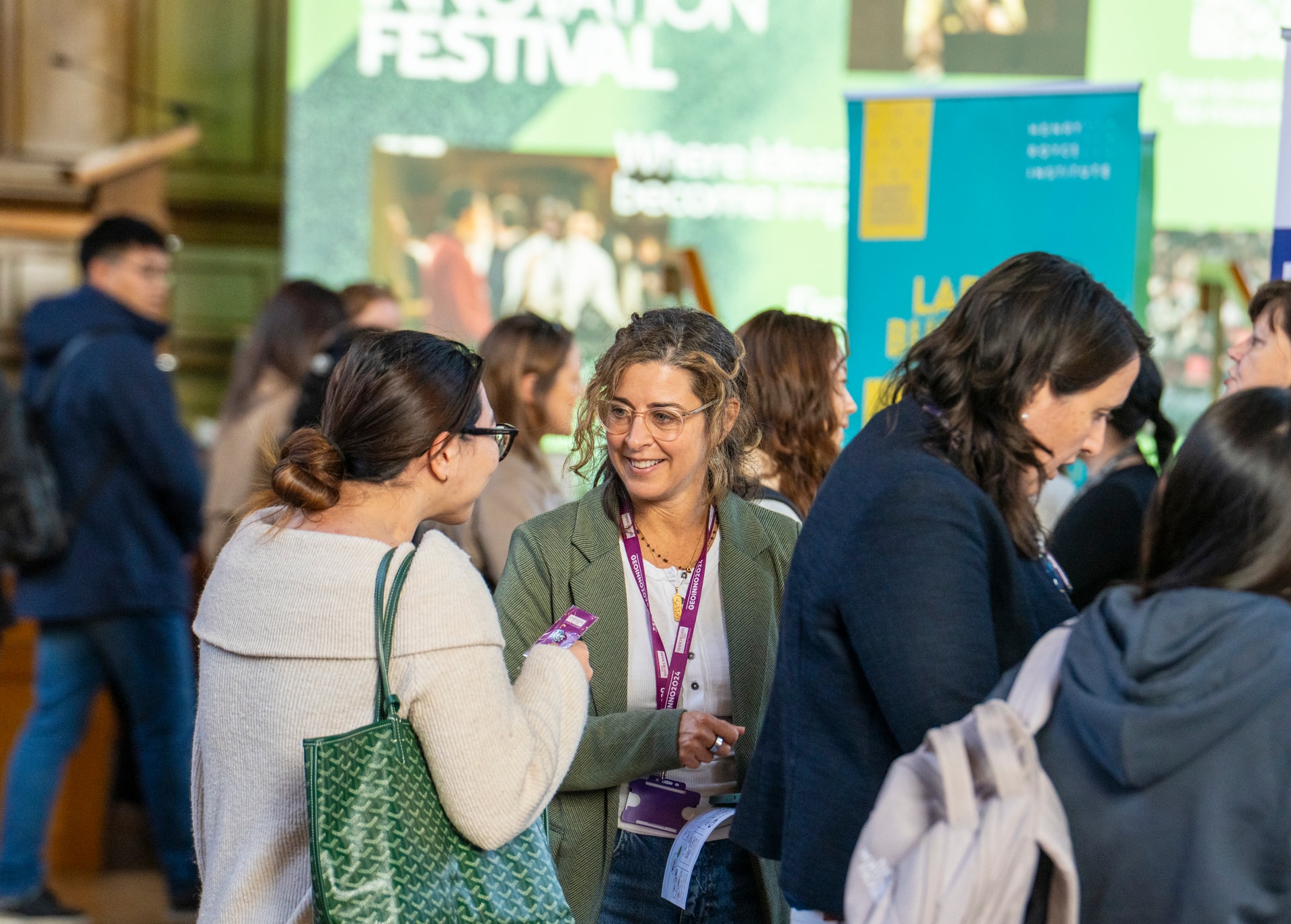
From established 20-year industry relationships to new alliances with partner cities, the University's first Innovation Festival showed just how much of Manchester's innovation depends on collaboration with others, and what it really takes to make those partnerships last.
2JJ06276
Summary
- The University of Manchester's first Innovation Festival brought together 3000 people across 25 events
- 116 speakers shared insights into innovation, investment and collaboration
- A new £10 million Founders Fund launched to provide University-affiliated ventures with early-stage investment.
"No matter how good we are as a university, we can only have the scale of impact we want by working with others," said Professor John Holden, Vice-President for Civic Engagement and Innovation, at the Partnership Excellence Awards on 7 October. The same idea ran through the entire Festival week.
Holden told the audience that, over the past year, the University has created 191 new business partnerships, around one for every working day. It is also among the UK’s leading universities for working with business: national figures ranked it second for contract research with SMEs and fifth for industry research funding.
Ask the people behind those partnerships what makes them work, and the same answers come up again and again. The first is time.
Trust is built over decades
Professor Simon Luckman, Brackenbury Chair of Physiology at The University of Manchester, has worked with Eli Lilly for around 20 years, most recently with Dr Amy Worth, who was shortlisted for the awards' Rising Star prize for their work on how GLP-1 drugs affect food cravings. Asked at the ceremony for the secret, he didn't hesitate: trust. "We've built it up over 20 years, so now there is very open and honest exchange." He has seen the alternative, too. Collaborations where each side keeps its cards hidden, he says, are "disastrous".
Manchester’s Professor Alan Dickson, Director of Centre of Excellence in Biopharmaceuticals (COEBP) and Professor of Biotechnology, told a similar story, on an even longer timescale, in a talk at the Festival's launch event on 5 October. In 1990 he was one of very few biologists in Manchester working with industry at all. Over the following decades he helped build networks that brought companies and academics together, eventually leading to strategic partnerships with AstraZeneca's biologics arm and FUJIFILM. His partnership with the latter on biomanufacturing won Research Collaboration Excellence at the awards.
Partnerships like these work, he said, because each side brings what the other can’t. “I’m just an academic. I can’t manufacture these things,” he explained of the cell and gene therapies his field is helping to create. Industry brings the scale-up, the regulatory know-how and the route to patients.
The benefits run both ways. "I didn't know how to project manage correctly until I started to work with companies," he admitted. The evening’s Strategic Alliance winner, Boots/No7, makes the same point at scale: more than two decades of skin science with Professor Michael Sherratt, Professor of Biochemistry at The University of Manchester, and Dr Abigail Langton has delivered products used by millions.
Partners who fill the gaps
Time builds trust, but a partnership only lasts if each side gets something it couldn't get alone, and that isn’t just true for multinationals. The night’s top prize, Partnership Excellence of the Year, went to Saraco Industries, which has worked with Manchester’s Professor Sarah Cartmell, Professor of Bioengineering, and Professor Andrew McBain, Professor of Microbiology, across several projects to develop plastic-free clinical disinfection wipes. It also took the Small Business award.
Sometimes what a partner brings is access to people. Dr Joanne Tippett's RoundView project, shortlisted at the awards, teamed up with Manchester City of Literature, which opened doors to libraries and schools. That let the team test its game-based sustainability tool with thousands of children, parents, teachers and librarians. Speaking at the awards, Joanne said a good partnership takes "the ability to try something out, find out it doesn't work, and learn from that and keep going".
download
“
The stronger Manchester gets, the more partners for us to work with, the more fertile the ground is for our spinouts to scale, the more attractive it is for students to come and work with us.
Professor John Holden, Vice-President for Civic Engagement & Innovation and CEO – Unit M
„

Someone must make the connections
Nothing can begin until the right people find each other. For anyone outside a university, finding the perfect partner inside one can be the hardest step. The University set up Unit M, its innovation arm, partly to fix that. Geraint North, who helped set up semiconductor manufacturer Arm's site in Manchester, now 650 people strong, told a panel at the Cambridge x Manchester Partnership Innovation Summit on 8 October that Unit M has opened up the University well beyond Arm's traditional links with computer science. Now that the company makes its own chips, it needs robotics engineers and future-of-work researchers too.
The same problem looks different from a founder’s side.
At the Powerhouse of Innovation Showcase in the University’s Whitworth Hall, some 25 of the teams, and partners that support innovation across the University gathered in one room, and for Veronica Ferguson, Head of Regional Operations at Innovate UK’s ICURe programme, that was the point. “There’s so many different offerings. It’s how do I navigate my way through that?” Bringing the providers together, she added, helps founders find “the person that can give them the next step”.
ICURe pushes researchers to test whether the market actually wants or needs their idea, across up to 100 conversations with customers, regulators and competitors. Its latest cohort, announced at the showcase, will work with materials researchers at the Henry Royce Institute, whose national hub is in Manchester. Royce opens up facilities and expertise across 11 partner sites, free for researchers and subsidised for SMEs and spinouts.
For James Baker, former Chief Executive of the Graphene Engineering Innovation Centre, interviewed during the Festival, the next job is to bring investors, bankers, entrepreneurs and the University together into “a more coherent whole”. Through his new consultancy, Baker Graphene, he works with advanced materials companies that are ready to move from early products to factories. That takes money to scale up, from a start-up’s first £150,000 to the £30 million it can take to build a factory.
Investors bring more than money
Investors in the north are rising to that challenge, and they bring more than money.
Northern Gritstone has £382 million to invest in science and technology companies from Manchester, Leeds, Liverpool and Sheffield. But Investment Director Cassie Docherty, speaking on the same summit panel as Geraint North, described the job as much wider than writing cheques. "We're capital, but we're there to help," she said, from finding talent to shaping strategy. Pairing an academic founder with an experienced executive chair, she argues, is one of the best ways to get through the "valley of death" between lab and market.
Professor Sam Butterworth, Professor of Medicinal Chemistry at The University of Manchester, who spoke at the Innovation Festival launch event, knows how those pieces fit together. His drug discovery project needed years of translational funding before investors were ready. An Innovate UK investor partnership grant finally gave it the "oomph", as he puts it, to persuade backers to commit. Northern Gritstone co-invested to form Apini Therapeutics, which raised £9 million in 2024 to develop a small-molecule therapy for inflammatory diseases, and is working towards clinical trials.
The University is adding its own tools. Alongside the non-equity Ideas with Impact Awards, its new Founders Fund, which aims to raise £10 million, will start making pre-seed investments in 2027. Niaz Rayan's agritech spinout Spore Sense shows how these steps build on each other: an Ideas with Impact Award, then a commercial development grant and now its first pre-seed round, with an eye on investors well beyond Manchester.
Two cities can be stronger than one
That kind of reach is exactly what the Cambridge x Manchester Partnership was set up to provide. It is the UK's first deliberately designed cross-city innovation partnership, and its director, Faye Holland, wants it to replace rivalry with something more useful.
“Our postcodes compete, our councils compete, our combined authorities compete,” she said, opening the partnership’s Innovation Summit. “I wonder why we don’t use the word ‘co-opetition’, where we bring collaboration and competition together in a really positive way. We’re not trying to make Cambridge look like Manchester or Manchester look like Cambridge. We want to work out what the uniqueness is of both of those different cities and see if we can achieve more by working together.”
Founders pitching at the summit's lightning talks are already seeing the benefit. Dr Videha Sharma's health-tech company, Fava Health, works with genomic sequencing and digital health partners based in both cities. "Building in healthcare requires partnerships and working together," he said.
Spore Sense is another. Its technology detects crop disease before symptoms appear, and its search for investors beyond Manchester leads naturally to Cambridge, close to its field trials in the east of England and to NIAB, the Cambridge-based crop science organisation that is one of its key research partners. The partnership, Niaz Rayan said, connects the company with “investors in Cambridge and other companies that have come out of Cambridge”.
The traffic runs the other way, too. Charlotte Ridley, whose Cambridge start-up is building technology to preserve families' digital memories, came north to join the summit panel. She already relies on marketing support based in Manchester. Cambridge excels at research and development, she said, but "the one bit we're missing is the creativity".
To make those connections easier, Faye Holland told the summit, the partnership is building an 'innovation passport', due to launch by the end of the year. It will give founders in one city easier access to space, accelerators, investors and corporate partners in the other. A joint investment prospectus for the two cities is also on its way, Shaun Grady, UK Chair of AstraZeneca, told the summit.
For Professor Dame Jessica Corner, Executive Chair of Research England, which funds the partnership, it’s an experiment. Interviewed at the summit, she said Cambridge has one of the strongest innovation ecosystems in the world, but it is close to overheating. "Could you drive the overheat into another city, Manchester, in order to grow the opportunity there? That's the experiment, and we'll see what happens." She will judge it on hard outcomes: venture capital concentrated in Cambridge moving north, and investment that would not otherwise have happened. "There are already early signs [of this]," she said.
Partnership that benefits and reaches the whole city region
In her summit address, Faye Holland called 'good growth' the objective that underpins everything the partnership does: making sure communities outside the innovation economy benefit too. It is a test for every partnership in this story. At a Festival panel on making Manchester a centre for inclusive innovation, Dr Julian Skyrme, the University's Executive Director of Social Responsibility and Civic Engagement, framed it as three questions: innovation for whom, by whom and how.
Some answers were on show. On the Festival's final day, the base build of the Sustainable Materials and Manufacturing Centre in Rochdale's Atom Valley was completed, with the University as lead delivery partner alongside Greater Manchester Combined Authority. It is forecast to generate £107 million in economic value over ten years. The Turing Innovation Catalyst Manchester has helped more than 1,500 people across the city region explore careers in AI, which its director, Elizabeth Scott MBE, called "a civic responsibility" while judging the Coller AI Competition on the Festival's final day.
Back at the Partnership Excellence Awards, United Utilities and One World Together were recognised for work on regional growth and with schools across Greater Manchester.
Reach out
None of these partnerships happened by accident. Each depended on someone willing to reach out, be honest when things weren't working and keep going. As John Holden put it, partnership working "depends on brave people".
The next step is to make those connections easier to find. That is why the University set up Unit M, its innovation unit, as “an open front door, building connections between industry, academia and our wider community”. Whether you’re an SME with a bottleneck, a start-up looking to scale or a researcher with the seed of an idea, Unit M is the place to start: unit-m.co.uk.