



Manchester, UK,
28
September
2026
|
16:58
Europe/London
Building tomorrow’s technologies, one atom at a time
From quantum computers to ultra-precise sensors, many of tomorrow’s breakthrough technologies depend on engineering materials at the atomic level. A new £12.6 million programme aims to use this to create advanced devices.
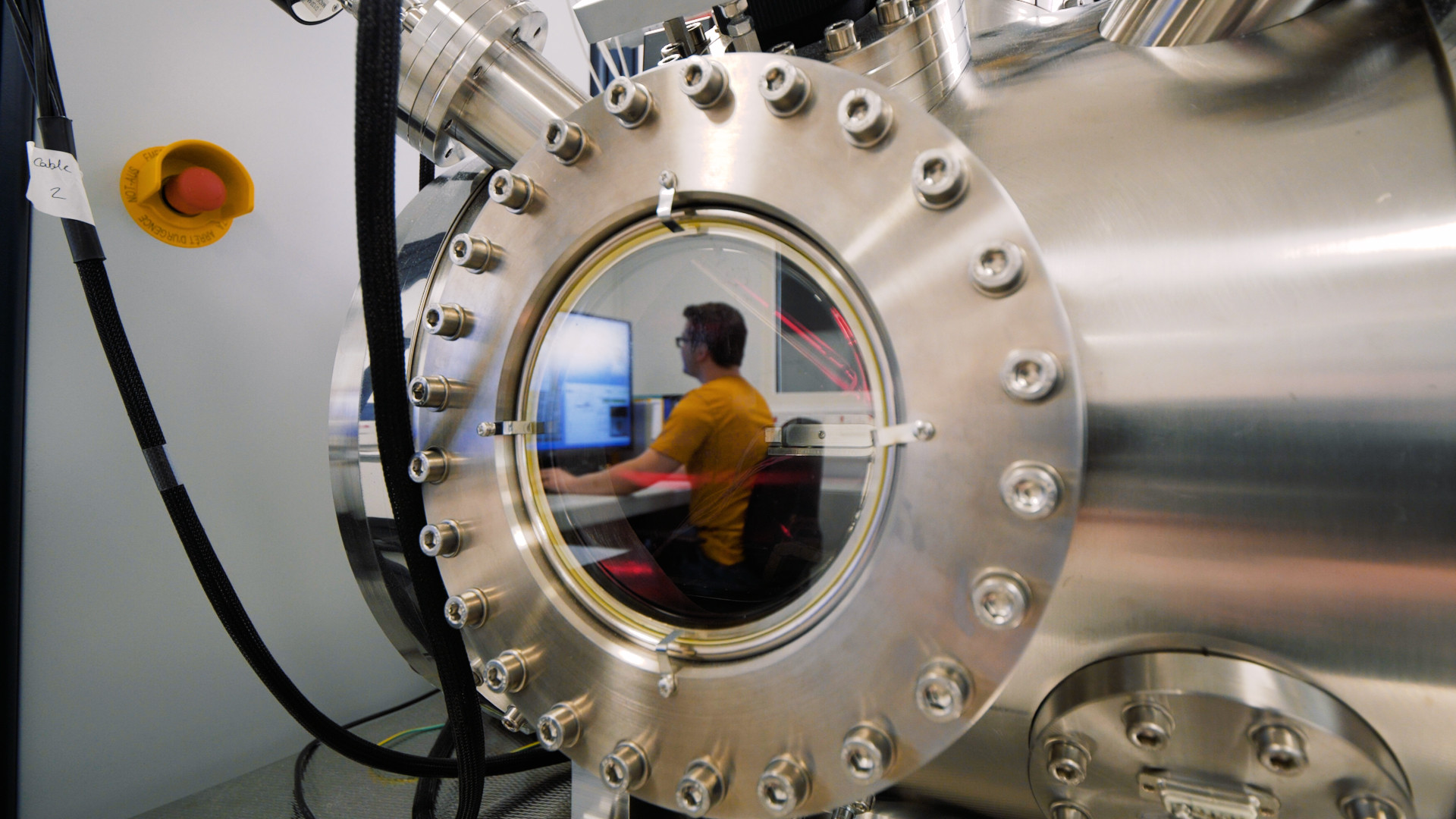
Researcher mirrored in P-Name that can implant individual atoms into a material with a precision of 20 nanometres
Researcher reflected in P-Name, one of The University of Manchester’s internationally unique instruments that can implant individual atoms into a material with a precision of 20 nanometres
From atoms to devices
A sensor so precise it can find buried pipes and cavities from the surface, without digging a single hole. A communications system where an eavesdropper cannot hide. A computer that can simulate the behaviour of molecules in ways that enable accelerated drug discovery and materials design.
What do each of these have in common? They’re all possibilities that quantum technologies offer and have a common challenge: the ability to engineer materials with such precision, that individual atoms can be placed where they’re needed and retain their quantum behaviour in ways ordinary materials simply can’t.
That is the ambition behind a new £12.6 million research programme, launched this year with funding from the Engineering and Physical Sciences Research Council (EPSRC). The programme, Materials Engineering for Advanced Devices (MEAD), is led by Manchester’s Professor Richard Curry, in partnerships with colleagues at Manchester, Imperial College London and the University of Leeds.
The precision problem
Quantum technologies work by exploiting the unusual rules that govern matter at the scale of individual atoms – rules that make certain capabilities in computing, sensing and communication possible, in a way that conventional electronics can’t achieve. Yet when a single misplaced atom can prevent a quantum device from working, understanding and controlling atomic-level structure isn’t just useful, it’s the whole game.
Manchester’s leadership of the MEAD programme starts here. The University is home to the Platform for Nanoscale Advanced Materials Engineering (P-NAME), a suite of three internationally unique instruments that can implant individual atoms into a material with precisions exceeding 20 nanometres – about 3,000 times finer than a human hair.
It was this capability, combined with advanced isotopic engineering (the use of specific atomic forms of an element that fine-tunes its quantum properties), that recently produced the world’s purest form of silicon. This research, published in the journal Communications Materials (doi.org/10.1038/s43246-024-00498-0), opens a new route towards quantum devices that can operate reliably without having to constantly correct for interference caused by unwanted atomic impurities (misplaced atoms).
“We’re all united in addressing the same challenge of building new devices, but at Manchester we’ll specifically use our expertise in engineering materials on the nanoscale, so that we can create a new set of advanced materials - specially designed to deliver the required quantum properties at the heart of these.
"We won't just study these materials and their quantum properties in the lab. We'll build them into working prototype devices to prove they can be used in real-world quantum technologies, such as quantum computers, secure communications systems and advanced sensors. Our ambition is for this research to have a transformative impact on how quantum technologies are applied in society."
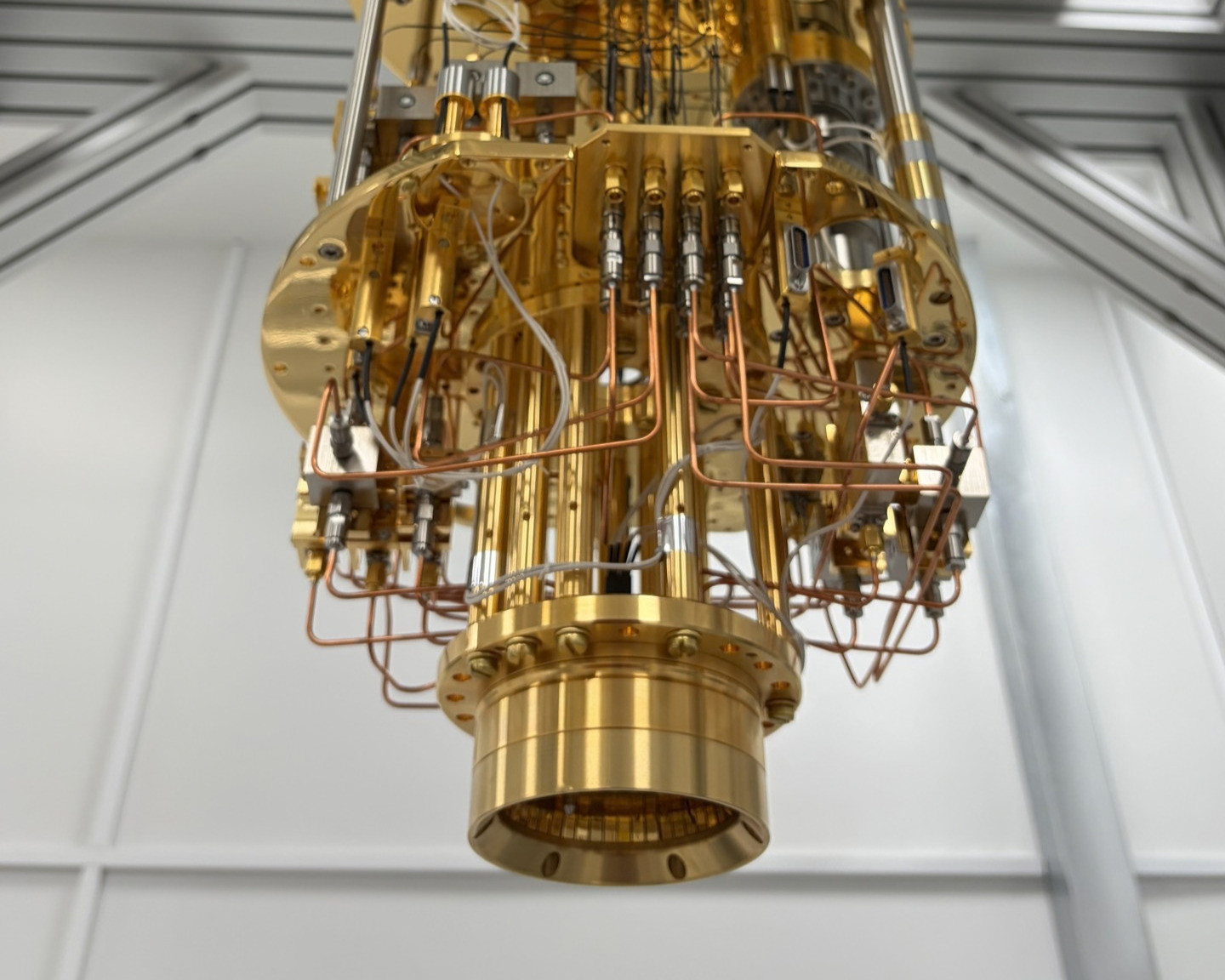
Dilution Fridge, The University of Manchester
The newly installed dilution fridge will enable Manchester researchers to study and test quantum devices by cooling them to temperatures just above absolute zero, where quantum behaviour can be reliably observed.
From atoms to devices
MEAD has three interconnected ambitions, and the first is to produce the building blocks that quantum technologies need.
Dr Jayadev Vijayan is developing a new class of quantum sensor aiming to use microscopic particles with quantum-engineered properties held in a vacuum. This approach could hugely increase the sensing performance of current technologies as existing trapped atoms devices are replaced by these macroscopic particles. Alongside this, Dr Huanqing Ye is working on single-photon sources: devices that emit individual particles of light (photons), which are essential for quantum-secured communications.
Meanwhile, Professor Richard Curry is leading work on using arrays of single atoms placed in isotopically pure silicon to demonstrate long-lived quantum properties for use in quantum computing. These materials will be tested in Manchester’s new Hi-CaLM facility, a system capable of cooling devices to temperatures just a fraction of a degree above absolute zero, where quantum behaviour can be observed and harnessed in realistic device conditions.
The second task is to develop tools that allow scientists to understand what is actually happening at the atomic scale.
Professor Sarah Haigh leads this work, aiming to extend materials imaging beyond the current limits. This should reveal not just where atoms sit, but which form (isotope) of each element they represent – something that determines how quantum devices behave.
Dr Jessica Boland is developing a technique that uses a form of light capable of passing through materials, to pinpoint the location of individual atoms within a working device without disturbing or damaging it.
Dr Katie Moore then uses a technique called nanoSIMS to verify, at the finest possible resolution, that the materials being engineered actually contain what they’re designed to. Being able to check materials at the atomic scale, and feed those findings back into the engineering process, is what will separate informed development from guesswork.
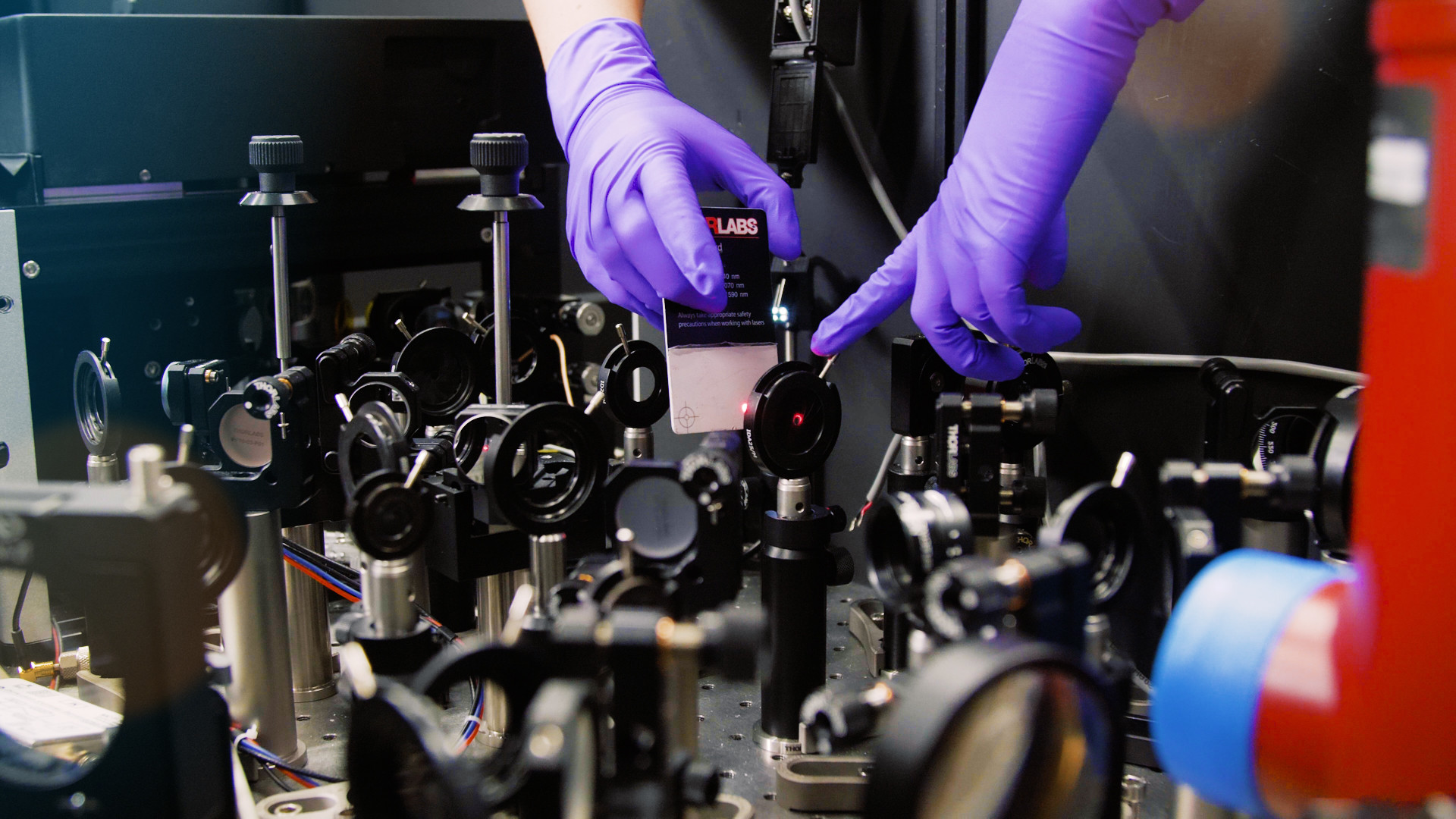
Close up of a researcher using CUSTOM cryogenic near‑field microscope
Jessie Boland will use CUSTOM cryogenic near‑field microscope capable of nanoscale mapping of electrical, optical and chemical properties at ultra‑low temperatures down to 30 nano metre length scales.
The third part of the programme focusses on masers – the microwave equivalent of lasers, capable of picking up and amplifying extremely faint signals while adding almost no interference of their own (perhaps think of a microphone that can amplify a whisper across a room without adding any noise to it).
This maser research is led by Professor Alford’s Imperial College London team, where the modern room-temperature maser was first developed.
Manchester’s Jodrell Bank Observatory will act as a testbed for applying this technology to ‘troposcatter communications’ – a method of bouncing signals to our upper atmosphere to carry communications over long distances without relying on satellites.
The Bragg Centre, housing the Leeds Nanotechnology Cleanroom, at the University of Leeds will make quantum devices from the materials that Manchester engineers, before returning them to Manchester’s Hi-CaLM facility for testing and analysis.
“
MEAD will build on our combined internationally recognised strengths in advanced materials, device engineering and quantum materials to deliver technologies that matter for national security, a new generation of sensing capabilities, and the future of quantum computing.
Professor Curry, Associate Vice-President for Research and Innovation, The University of Manchester
„

The programme draws on more than £150 million of existing infrastructure across the three institutions, often using facilities or equipment that have taken decades to build.
For the UK, which has committed billions to quantum technology investment, MEAD represents an investment on building the scientific foundations that we’ll need to achieve our goals.
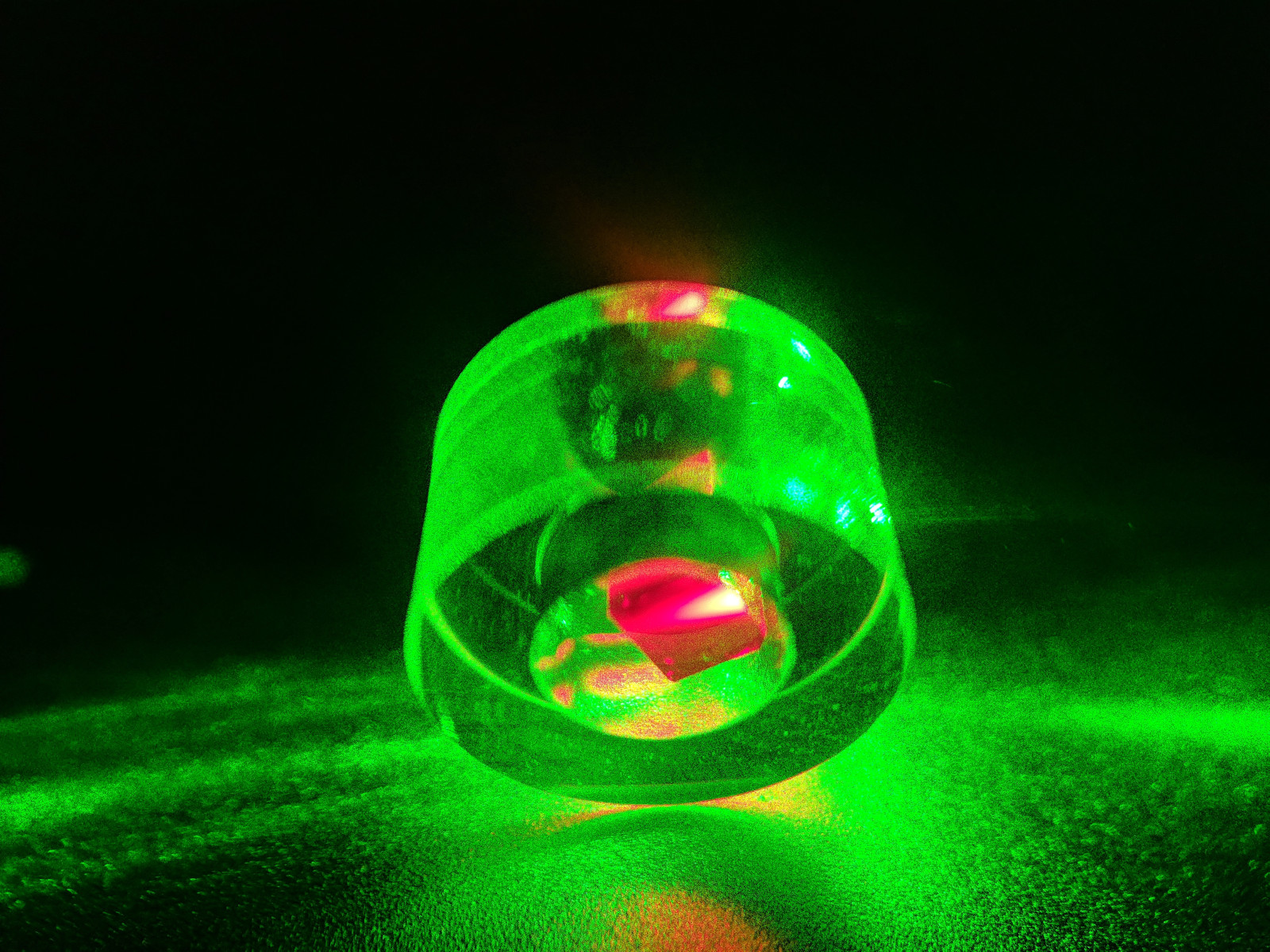
MEAD will use atomic-scale materials engineering to unlock new capabilities in communications, sensing and computing, by developing devices such as highly sensitive masers, the microwave equivalent of lasers
Explore MEAD
Are you a potential partner interested in developing the next generation of advanced electronic, optical and quantum devices by engineering materials with single-atom and isotope-level precision? The MEAD team would love to hear from you.
- Email Professor Rich Curry >> richard.curry@manchester.ac.uk
- Visit the project page >> https://mead-research.org/