



24
November
2026
|
11:01
Europe/London
Glucose sensors for type 2 diabetes deserve second look from NHS
A wearable sensor that allows people with type 2 diabetes using insulin to track their glucose levels in real time could prove good value for the NHS, a University of Manchester led study suggests.
FSL_Coffee_Making_Resized
The study, published in Diabetes, Obesity and Metabolism, assessed the value for money of real-time continuous glucose monitoring compared with standard finger-prick testing.
The National Institute for Health and Care Excellence (NICE) concluded in 2022 that real-time glucose sensors were not cost-effective for adults with type 2 diabetes. The authors suggest this advice may now be outdated based on new evidence.
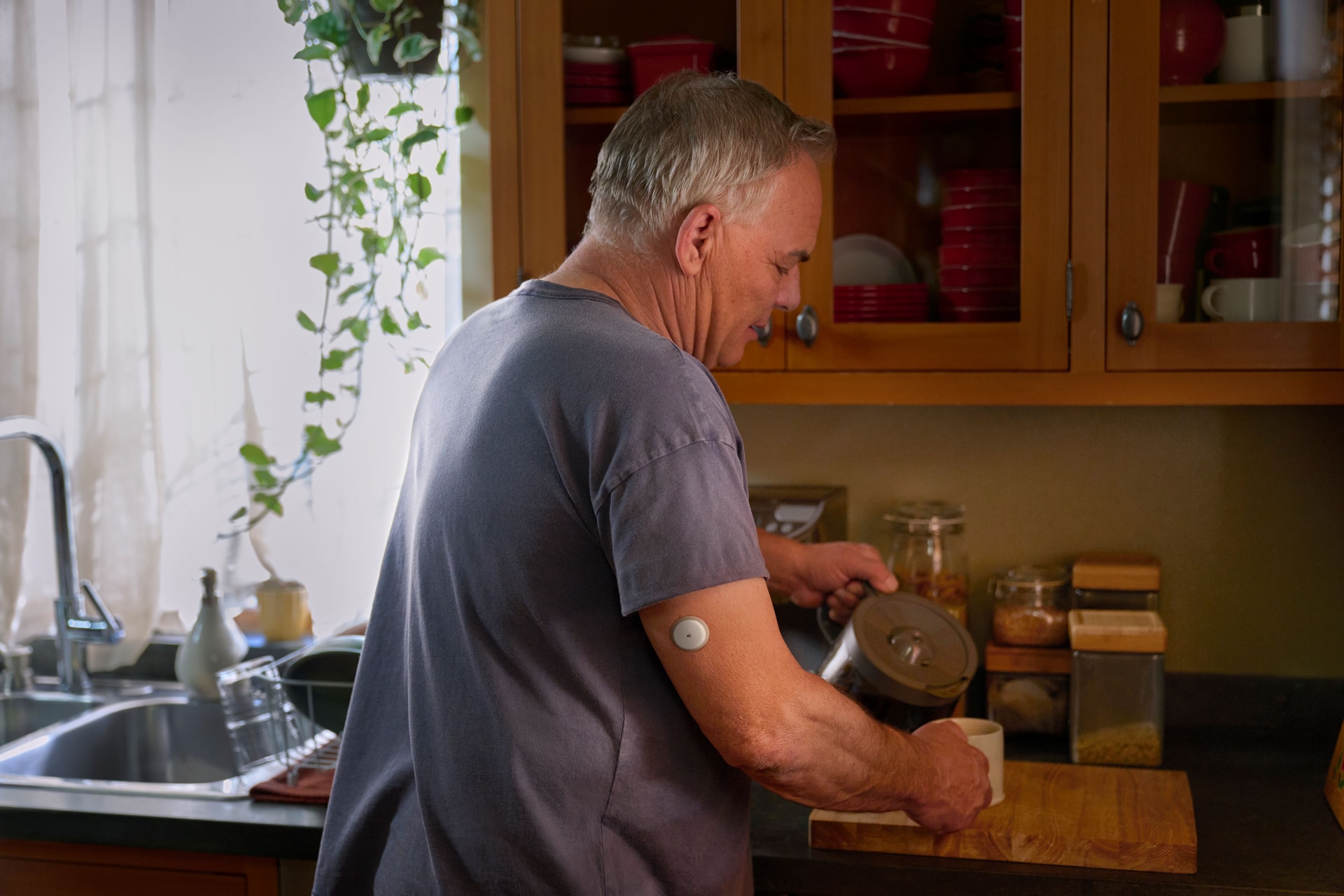
Rather than pricking a finger to test a drop of blood, people using the technology wear a small sensor that sends glucose readings from under the skin automatically to a smartphone or handheld reader.
An estimated 5.8 million people in the UK are living with diabetes, according to Diabetes UK, and around 90% of those diagnosed have type 2.
Type 2 diabetes costs the UK an estimated £8.8bn in 2021/22, with 64% of that linked to complications such as heart disease, kidney failure, sight loss and amputations.
The researchers used data from the FreeDM2 trial, in which 303 adults at 24 UK centres were randomly assigned to Abbott’s FreeStyle Libre 3 sensor or finger-prick testing for 32 weeks.
All had above-target glucose levels despite taking insulin and other diabetes medicines.
Those who used the sensor in the trial improved their glucose levels more significantly compared to finger-prick testing.
The researchers fed the trial’s glucose levels improvements into an established computer model to project health outcomes and costs over a lifetime.
“
For people with type 2 diabetes who use insulin, being able to choose a sensor over finger-prick testing can make managing their condition easier. Our results suggest this technology offers good value for the NHS, as long as people use the sensor to manage their glucose levels for 4 or more years
Professor Rachel Elliott, Professor of Health Economics at The University of Manchester
„

The sensors were projected to cost an extra £4,341 per person, while adding 0.73 quality-adjusted life years (QALYs), a measure combining length and quality of life.
This equates to £5,943 per QALY gained, well below the £25,000–£35,000 threshold typically used in England to judge whether a treatment is cost-effective.
The sensors were also projected to cut spending on complications by £2,437 per person.
Improvements in glucose control would need to last at least four years for the sensors to be cost-effective.
The study, led by the University of Manchester and supported by healthcare company Abbott, is the first UK economic evaluation of the technology’s long-term costs and benefits to use data from a randomised controlled trial.
Professor Rachel Elliott, Professor of Health Economics at The University of Manchester, said: “For people with type 2 diabetes who use insulin, being able to choose a sensor over finger-prick testing can make managing their condition easier. Our results suggest this technology offers good value for the NHS, as long as people use the sensor to manage their glucose levels for 4 or more years.”
During the 32-week trial itself, there were no significant differences in costs or quality of life, which the researchers say is expected as the benefits build up over time.
The long-term findings assume that people keep using the sensors and maintain their improved glucose levels.
- The study was funded by Abbott’s diabetes care business, which makes the FreeStyle Libre Continuous Glucose Monitoring System. The funder had no role in designing the economic evaluation, analysing the data or writing the paper.
- The paper A Cost- Effectiveness Analysis of FreeStyle Libre Real- Time Continuous Glucose Monitoring System Compared With Self- Monitoring of Blood Glucose in Adults With Type 2 Diabetes on Basal Insulin Plus SGLT2 Inhibitor and/or GLP- 1 Agonists in the United Kingdom is published in Diabetes, Obesity and Metabolism DOI https://doi.org/10.1111/dom.71476
- The article was written by science communications masters student Sofia Woodfine