



09
October
2026
|
11:15
Europe/London
Manchester and Cambridge bet on 'co-opetition' to take on the world
Day four of the Innovation Festival looked outwards from Manchester to the world. At the inaugural Cambridge x Manchester Partnership Innovation Summit, founders, investors, and policymakers asked how two cities working together could boost the UK’s position on the world stage – using a combination of cooperation and competition.
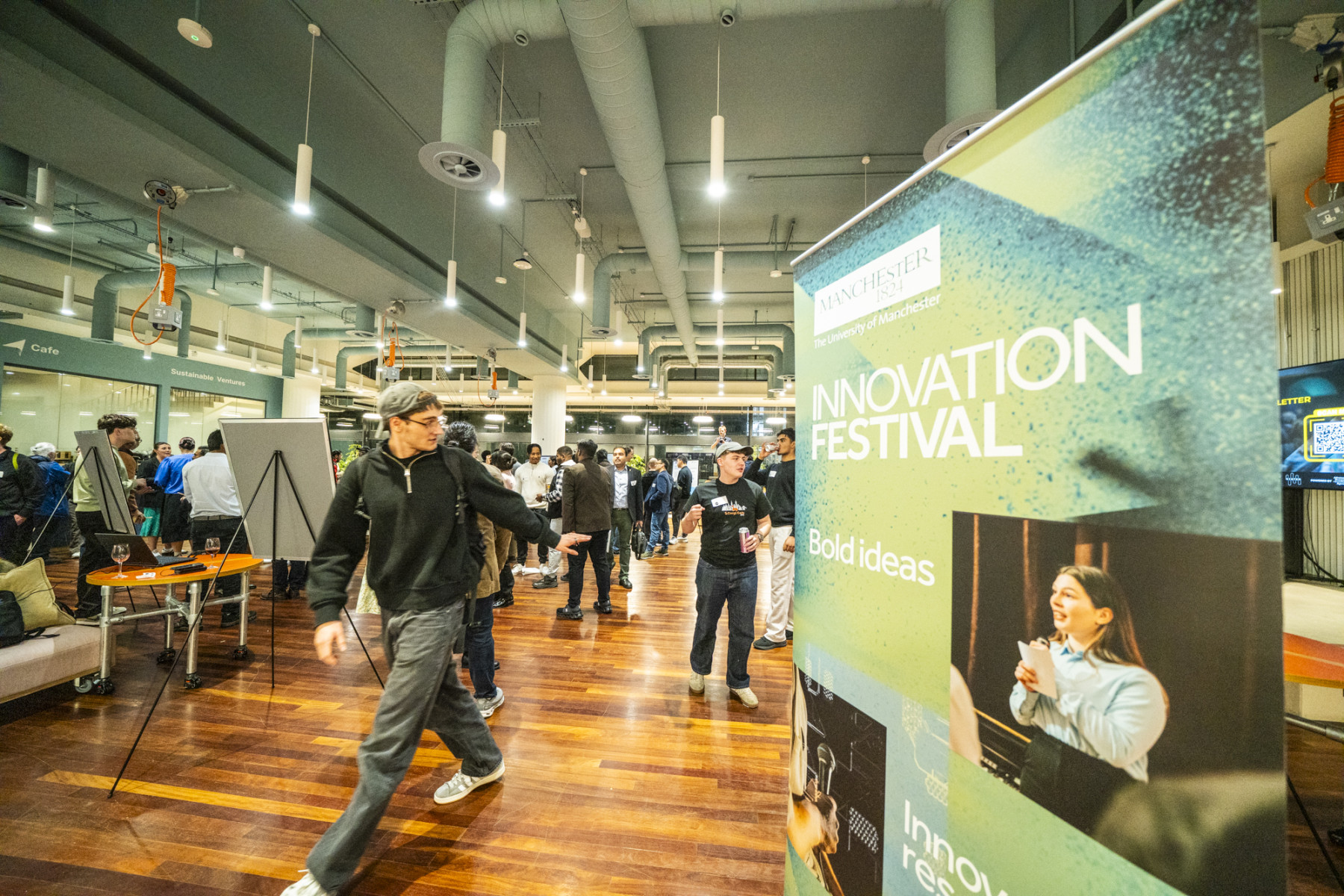
Innovation Festival
Innovation Festival
Summary
Two cities, one global ambition.
Cambridge and Manchester have joined forces to compete with the world.
Where earlier days celebrated what Manchester is building, Thursday looked outwards. The first Cambridge x Manchester Partnership Innovation Summit filled Sister to the brim with founders, researchers, investors and policymakers from both cities. Panels explored the partnership’s mission to ‘supercharge innovation-led growth’, with speakers from the University, Arm, Northern Gritstone, No. 10 North, UKRI and the British Chambers of Commerce.
Six Manchester founders pitched their innovations in lightning talks, and Bev Craig, Mayor of Greater Manchester, gave the keynote before closing remarks from University of Manchester President and Vice-Chancellor, Duncan Ivison and Shaun Grady, UK Chair of AstraZeneca. The Investor Summit continued the conversation on growth capital in the afternoon. In the evening, University of Manchester founders pitched to investors, mentors and partners at Manchester Venture Builder Demo Day, also at Sister, while Holiferm’s co-founders shared how they built their biotechnology company at The Founders Playbook at Manchester Museum.
Co-opetition: the experiment linking two innovation powerhouses
Opening the summit, Faye Holland, Partnership Director of the Cambridge x Manchester Partnership, argued that the UK's challenge may be less about talent or funding than about systems. The partnership is the UK's first deliberately designed cross-city innovation partnership, with three objectives: driving economic growth, building for global growth, and making sure that growth is good growth that reaches communities beyond the innovation economy. Duncan Ivison, President and Vice-Chancellor of The University of Manchester, said the UK too often gets caught in binaries, such as north versus south, and needs to "multiply our relationships, not narrow them" to compete globally.
“What typically happens is we compete. Our postcodes compete, our councils compete, our combined authorities compete… I wonder why we don't use the word co-opetition, where we bring collaboration and competition together in a really positive way… We only have three years from start to finish to prove that this model can actually work.” — Faye Holland, Partnership Director, The Cambridge x Manchester Partnership
“Cambridge and Manchester are not rivals; they are increasingly one ecosystem, and the UK innovation economy, as a whole, is stronger for it.” — Shaun Grady, UK Chair, AstraZeneca
Six ventures, five minutes each: Manchester’s ideas take the stage
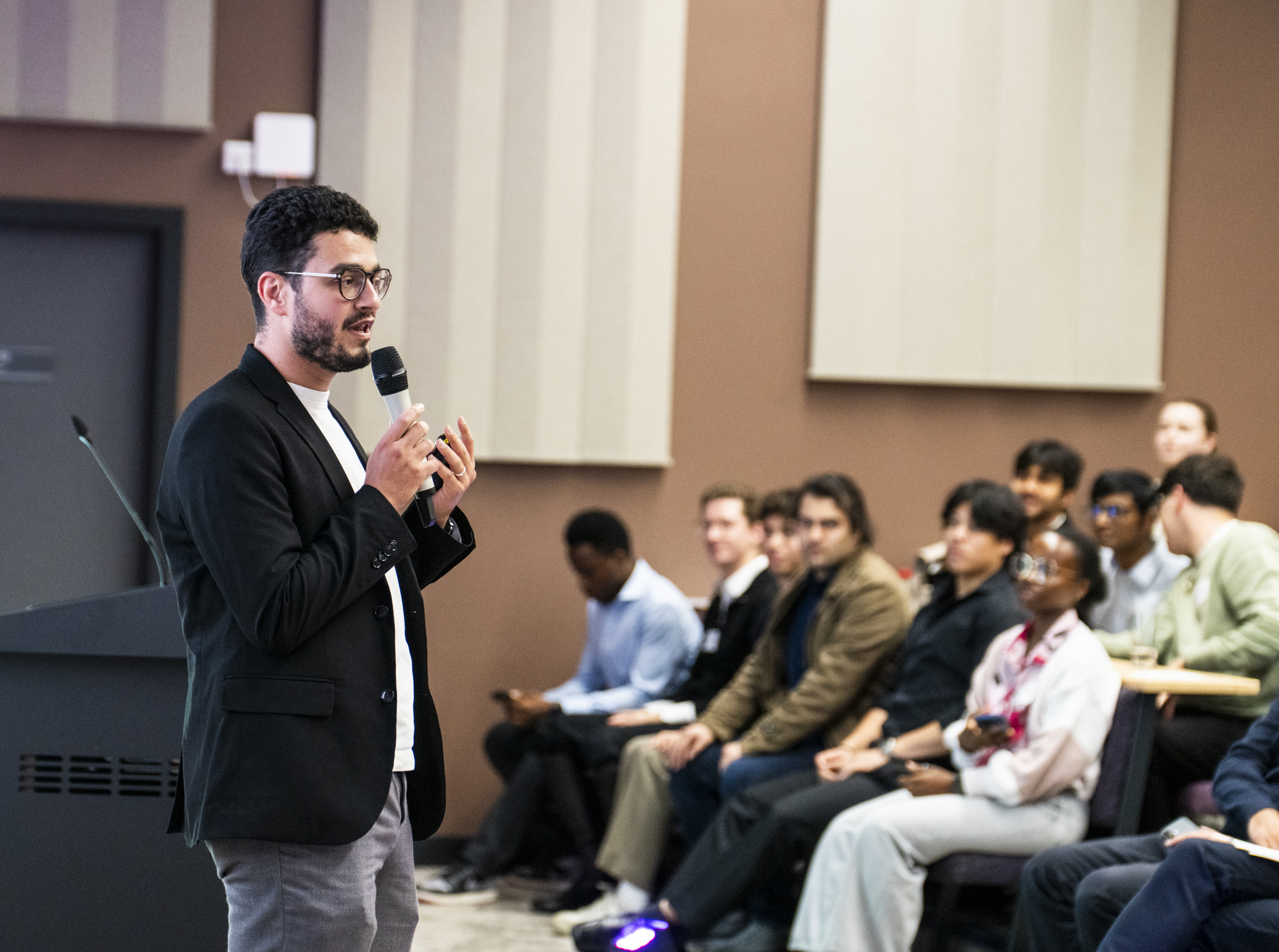
Six lightning talks showed the kind of companies the partnership wants to help scale. Hosted by Dr Karim Bahou, Head of Innovation at Sister, the founders pitched for the audience’s vote. Alongside pitches from N:SYM and Nanoco, Spore Sense, which spun out of the University just four weeks ago, has developed a sensor that detects crop disease before symptoms appear. Silveray has invented flexible digital X-ray film for inspecting pipes and welds, an industry still largely reliant on analogue film. CircKit is helping fashion brands design waste out from the start, and Fava Health is bringing genomics into everyday healthcare for better personalised treatment.
“There is still a major imbalance in where innovation capital flows within the UK… Around 80% of venture capital still remains within London, Oxford and Cambridge… A big part of the opportunity is making it easier for founders to move between these two ecosystems, and share deal flow across both of these regions.” — Dr Karim A. Bahou, Head of Innovation, Sister
“
What typically happens is we compete. Our postcodes compete, our councils compete, our combined authorities compete… I wonder why we don't use the word co-opetition, where we bring collaboration and competition together in a really positive way… We only have three years from start to finish to prove that this model can actually work.
Faye Holland, Partnership Director, The Cambridge x Manchester Partnership
„

Competing with the world, not each other
A panel chaired by Fiona Tuck of Metro Dynamics asked what Britain’s innovation economy still lacks. Professor Dame Jessica Corner, Executive Chair of Research England, said the UK is too small to treat its regions as separate innovation ecosystems, with capital “stuck” in the places that are already well resourced. Harriet Gordon, Deputy Director at No. 10 North, said the UK’s real competition is Boston, Silicon Valley and Paris: for investors, the choice is rarely Manchester or Liverpool, but Manchester or Munich.
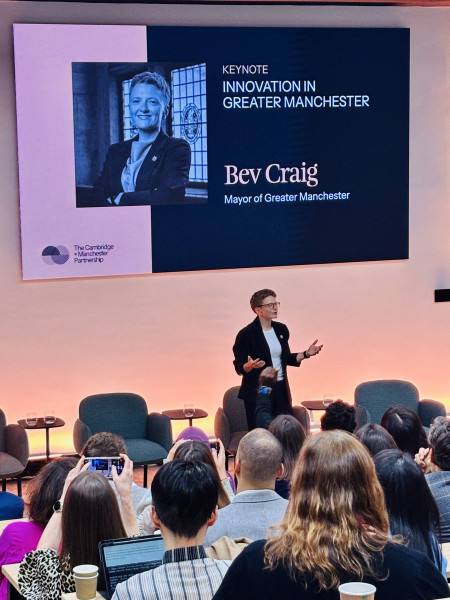
In her keynote, Bev Craig, Mayor of Greater Manchester, said regions need to “complement each other, not just compete with each other”, and set out a vision of good growth that people can feel in their daily lives.
“Simply creating growth to impact on someone’s bank balance, without seeing the number of jobs increase and the quality of someone’s life improve, is just growth for growth’s sake.” — Bev Craig, Mayor of Greater Manchester
Announcements and developments
- The Cambridge x Manchester Partnership will launch an “innovation passport” by the end of the year, giving founders and researchers easier access to office space, accelerator programmes, investors and corporate partners across both cities.
- A joint investment prospectus for Cambridge and Manchester is on its way, Shaun Grady, UK Chair of AstraZeneca, told the summit, urging investors to “get in early”.
Manchester 2035: voices from the Festival
“I would hope that eight- and nine-year-olds growing up in Ardwick and Brunswick, right next to us, or a young person growing up in Rochdale, not only see the University as part of the place they live, but see it as theirs in some way.” — Duncan Ivison, President and Vice-Chancellor, The University of Manchester
“By 2035, I’d expect to see Graphene in many products, from shoes to clothing to computers to tyres to aircraft – not in there because it’s Graphene, but because it’s adding competitive advantage.” — James Baker, founder, Baker Graphene, and former Chief Executive, Graphene@Manchester
Demo Day
On Thursday evening, the Masood Entrepreneurship Centre and Venture Café Manchester hosted Manchester Venture Builder Demo Day 2026 at Sister. University of Manchester founders from the Venture Builder programme took to the stage to pitch ventures they had spent months testing and refining. They ranged from Remi, a platform that helps therapists manage clients and build personalised exercises, to a student startup growing organic bananas and drying them with solar power. Investors, mentors, alumni, corporate partners and a delegation from Hartford in the US then joined the founders for a showcase and networking reception, continuing the outward-looking theme of the day.
“I’ve made more progress in the paste ten minutes of networking here than in the past 30 days of cold emailing and cold LinkedIn messaging!” — Jacob Katz, founder, AMBS, BSc Management with Strategy, Innovation, and Entrepreneurship
"Innovation doesn't happen just because you have a great idea… Getting people that have money, people that have technology, people that know how to do business – you can't do it on your own, but you can pull them together into one location." — Gene Goddard, Chief Business Investment Officer, Metro Hartford
Around the Festival
Away from Sister, Sow the City shared community-led social innovation at Manchester Museum’s Growing Change event, and Sustainable Futures showcased funded projects at Inclusive Innovation for People and Planet. Beyond the Hearing Loop explored how Auracast audio technology could benefit deaf, hard-of-hearing and neurodivergent communities, and the University and national initiative, E3M met to discuss social enterprise innovation in public services.
Coming up
The Festival closes on Friday 9 October with the final of the Coller AI Competition, where University of Manchester AI startups pitch live for a £100,000 equity investment from The Jeremy Coller Foundation.