



18
November
2026
|
12:12
Europe/London
Manchester Humanities researchers recognised for global influence
Two researchers from The University of Manchester’s Faculty of Humanities, whose work explores the transition to a low-carbon society and the causes and consequences of loneliness, have been named in Clarivate’s 2026 Highly Cited Researchers list.
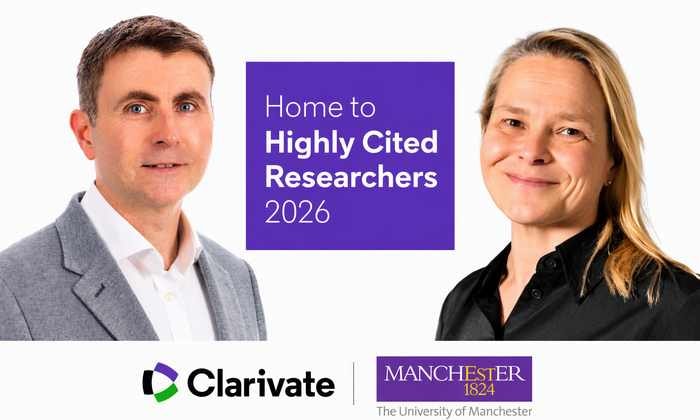
UoM_Clarivate_StaffNet_700x420
Summary
- Professor Frank Geels and Professor Pamela Qualter are recognised for the influence of their research, with Geels listed in Social Sciences and Qualter in the Cross-Field category.
- They are among nine researchers affiliated with Manchester to receive the recognition this year.
Professor Frank Geels and Professor Pamela Qualter are recognised for the influence of their research, with Geels listed in Social Sciences and Qualter in the Cross-Field category. They are among nine researchers affiliated with Manchester to receive this recognition this year.
Understanding how societies move towards sustainability
Frank Geels is Eddie Davies Professor of Sustainability Transitions at Alliance Manchester Business School. His research examines how societies can transform the systems that provide energy, transport, heating and food to address environmental challenges.
He pioneered the Multi-Level Perspective, a framework for understanding how new technologies and innovations interact with established industries, public policy and wider social change. His work looks beyond technological breakthroughs alone to explore the roles of businesses, governments and citizens in accelerating – or resisting – the shift to low-carbon systems.
Geels has brought these insights to international policy discussions, including as a Lead Author of the Working Group III contribution to the Intergovernmental Panel on Climate Change’s 2022 Sixth Assessment Report.
Building understanding of loneliness and social connection
Pamela Qualter, based in the School of Environment, Education and Development, studies loneliness across the life course, with a particular focus on children and young people. Her research explores why loneliness develops, how it affects people over time and what can help prevent it from becoming persistent.
She led the BBC Loneliness Experiment and works with the UK Government’s Tackling Loneliness Team, including on identifying gaps in the evidence. Her research also examines how the places young people live, and their experiences of social media relate to their social and emotional lives.
Her projects include developing a new measure of loneliness for young people, supported by the Medical Research Council, and evaluating an intervention for primary school-aged children in the UK, funded by the Kavli Trust.
“
Congratulations to Frank and Pamela on this recognition of the international influence of their research. Their work shows why Humanities and social sciences are essential to understanding and responding to challenges that affect people’s lives, from the transition to a low-carbon society to loneliness and social connection.
Citations are one indication of how research informs further scholarship, but our ambition goes beyond the numbers. We want to support research that brings disciplines together, informs policy and practice, and reaches the people and communities who can benefit from it.
Professor James Evans, Vice-Dean (Research and Innovation) for the Faculty of Humanities
„

For 2026, Clarivate recognised 6,802 researchers across more than 1,200 institutions in 62 countries and regions. The Cross-Field category recognises influence spanning multiple research fields.
Researchers are selected using citation data from the Web of Science Core Collection, alongside further quantitative and qualitative analysis. To qualify, each researcher must have authored a minimum number of Highly Cited Papers. These papers rank in the top 1% by citations for their field and publication year during the 11-year period from 2015 to 2025.