



27
November
2026
|
12:20
Europe/London
Researchers call for a better understanding of who benefits from new green space
New international framework aims to help cities understand why green spaces help some residents more than others
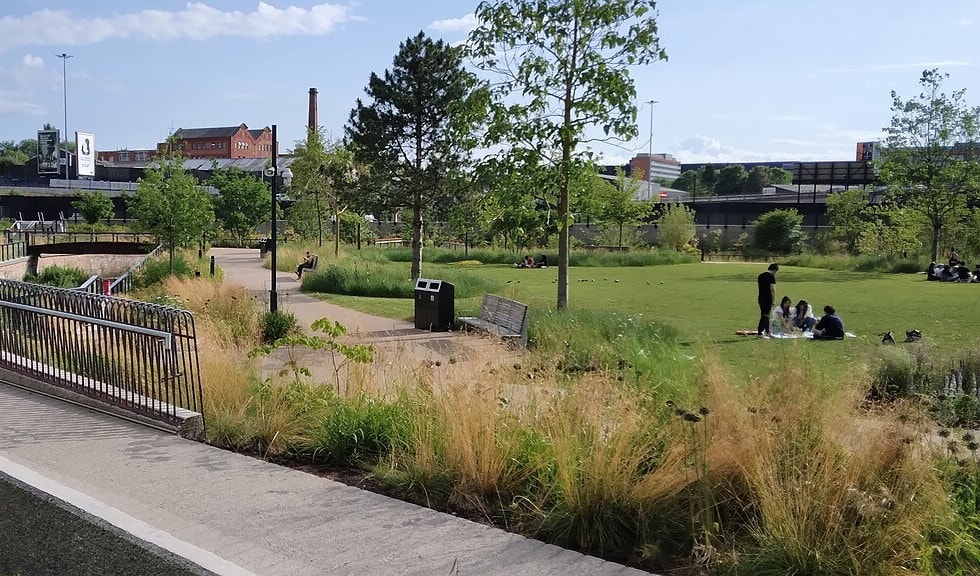
Mayfield Park - photo republished from Wikimedia Commons
Photo republished from Wikimedia Commons
Parks, woodlands, rivers and other natural spaces can improve physical and mental health, encourage exercise and help cities cope with extreme heat and flooding - but simply creating more green spaces does not guarantee that everyone will benefit equally.
Researchers from The University of Manchester have developed a new framework to help planners understand what makes environmental improvements successful, who benefits and why their impact varies between communities.
Key findings
- Green spaces can support physical and mental health, but benefits are not necessarily shared equally without explicit consideration of the needs of different residents
- Multiple factors – such as safety, accessibility and cultural preferences - can influence whether people use and benefit from parks
- Green space improvements can sometimes have unintended consequences that must be considered, including displacement of residents and increased inequality
GIFT framework
The GIFT (Green and blue space Intervention Framework for Theory development) provides practical guidance for evaluating how green space interventions work and who benefits.
It was developed by 25 researchers from eight countries, with support from The University of Manchester's Research Collaboration Fund.
Why more green space doesn't always mean better health
Although access to green and blue spaces is linked to better health, evidence about the impact of specific improvements, such as renovating parks or planting trees, remains limited.
The same intervention can have very different effects depending on the neighbourhood and its residents. For example, concerns about antisocial behaviour or personal safety might prevent some people from using a redesigned park, while communities with fewer existing green spaces could benefit particularly strongly.
Environmental improvements can also contribute to green gentrification, where rising property prices displace the communities they were intended to benefit.
An international collaboration
The GIFT framework provides a structured approach to assessing five areas: the intervention itself, how it influences behaviour and health, differences between population groups, local circumstances, and the timescales over which benefits or unintended harms emerge.
The researchers demonstrate its application through improvements to a community park in a deprived neighbourhood in Manchester, showing how factors including safety, discrimination and cultural preferences can influence who benefits.
The project brought together 25 researchers specialising in public health, environmental science, geography and urban planning from the UK, Australia, Denmark, Mexico, the Netherlands, New Zealand, Spain and the USA.
Supported by The University of Manchester's Research Collaboration Fund, the collaboration involved an international survey and a two-day workshop hosted in Manchester in October 2025, followed by further work to develop the framework.
"We know that green and blue spaces can be good for our health, but we cannot assume that simply creating or improving these spaces will benefit everyone in the same way,” said lead author and Leverhulme Early Career Fellow Dr Jack Benton from the University's Department of Geography. “Factors such as whether people feel safe and whether a space meets the needs of their community can make a real difference.”
“
With GIFT, we want to help decision-makers ask better questions about who benefits from environmental improvements and where they might fall short, ultimately helping create healthier and fairer places.
Dr Jack Benton
„

Publication details
This research was published in: The Lancet Public Health
Title: Strengthening public health research on urban green and blue space interventions: the GIFT framework for theory development
DOI: 10.1016/S2468-2667(26)00225-2
URL: https://www.sciencedirect.com/science/article/pii/S2468266726002252