
Fallowfield Campus Redevelopment Project
The University of Manchester is delivering a major phased redevelopment of its Fallowfield campus, replacing older accommodation at Owens Park, Oak House and Woolton Hall with a modern, sustainable and more accessible residential campus. Once complete, the project will increase the number of bedrooms on site to around 5,400.
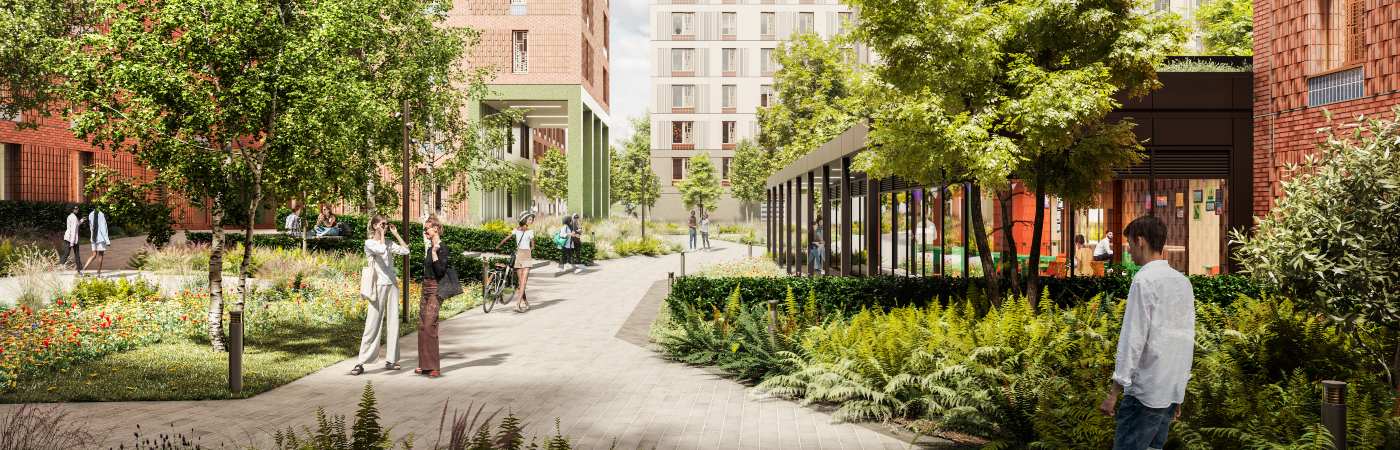
The redevelopment will create five new residential neighbourhoods, supported by local hubs, a new central hub, landscaped green spaces and improved walking and cycling routes. It has been designed to support a safe, inclusive and connected campus environment, with modern shared facilities, dedicated wellbeing spaces and improved access across the site.
The scheme is a significant investment in the city of Manchester and the experience of future University of Manchester students. It is set to become the world's largest single-phase Passivhaus student accommodation development, combining exceptionally low energy demand, net zero carbon operations and a major programme of biodiversity, wellbeing and social value measures.
The redevelopment is part of an innovative new partnership model being delivered by the Viridis consortium, working with The University of Manchester, Rothesay, Equitix, GRAHAM, Places for People Students (PfPS) and architects Sheppard Robson. The name, Viridis, translated as 'green' from Latin, encapsulates the consortium’s aspiration to build a greener, sustainable future at the Fallowfield Campus, rooted in the delivery of an unrivalled student experience.
Outline Planning Permission for the principle of the development was granted in January 2024.
Redevelopment of the site following demolition of the existing buildings represents the best option to achieve a student experience aligned to students’ expectations in today’s competitive accommodation market.
The project will aim to:
- Meet demand for University-managed accommodation.
- Offer a mix of bedrooms to cater for different needs and price points relative to the wider market in the city.
- Ensure both initial construction and long-term operation are aligned with our approach to environmental sustainability.
Alongside this, the Fallowfield Campus has the potential to contribute wider benefits to the city beyond the need for student beds. The delivery of modern student accommodation promotes city-wide regeneration objectives in supporting employment growth, graduate and talent retention and developing Manchester as a city of choice on the international market, and in supporting the wider housing market by catering for specific needs.
The planned layout reflects the University’s commitment to provide accommodation that creates an enhanced student experience to stimulate academic endeavour.
Key elements of the proposed layout are as follows:
- Accommodation blocks are arranged to create five vibrant new neighbourhoods each with their own identity and sense of place.
- Each of the five neighbourhoods will have a dedicated ‘Local Hub’ providing study spaces, laundrette facilities and postal services, alongside landscaped courtyards and outdoor areas to encourage social interaction and wellbeing.
- The main central hub will act as a focal point for campus life, retaining popular features such as the student bar while introducing extended catering, bookable social and study spaces, music practice rooms and dedicated wellbeing facilities. The hub is designed to provide additional social space for residents and students living in the Fallowfield area.
- A new primary avenue will connect the existing main entrance to the west (on Wilmslow Road) along a colonnaded and animated street to the new central hub facility on the eastern boundary.
- A secondary hierarchy of planned routes and vistas will help students travel around the site and contribute towards a community-focused approach. This will be supplemented by a tertiary series of meandering paths through the site that take advantage of its leafy setting, encouraging use of the external space.
The scheme has been designed around student wellbeing, with measures covering daylight, air quality, acoustic performance, overheating protection, accessibility and access to nature. Active travel will be supported through limited vehicle access, secure cycle storage, cycle repair stations, clear wayfinding and public transport information displays.
Demolition of the Owens Park Tower and Oak House was completed in the summer of 2026, with the demolition of Woolton Hall following shortly afterwards.
The Fallowfield campus redevelopment project will be delivered in phases, with the first 1,000 rooms due to open in 2028. Subsequent phases, including additional accommodation and the central hub facilities, will be completed in 2029, with the remaining rooms becoming available in 2030.
The University is committed to keeping disruption to existing students and the local community to a minimum. The management team for the project is working closely with these groups to identify and resolve any issues that may arise during the project.
Find out more about the project timeline and mitigations in place.
Sustainability is central to the Fallowfield campus redevelopment, which will set a new benchmark for low-carbon student living at scale. The residences are designed to reach net zero carbon operations, with modelled energy performance around half that of a standard new-build purpose-built student accommodation scheme. This will be achieved through a fabric-first approach, passive design measures, heat recovery, photovoltaic panels, air source heat pumps and renewable electricity supply.
The project will also reduce construction impacts through low-carbon concrete, efficient structural design, simplified finishes, off-site manufacture and verified environmental products.
The development is expected to deliver a biodiversity net gain of 11.7%, with extensive green spaces, planting and walking routes integrated across the site. The landscape strategy includes new habitats, green corridors, growing spaces, orchards, quiet spaces, exercise areas, biosolar roofs, bird and bat boxes, plus a hibernaculum to support ecological resilience.
The development has been carefully planned to minimise any loss of trees. Throughout the site, historical bands of mature trees will be retained wherever possible, although 82 trees will need to be removed for construction purposes and to allow the new blocks to be built. The landscape proposals will improve the long-term resilience of the tree population by planting new trees to replace those removed and selecting species that have adaptability to climate change, as well as biodiversity value. It is envisaged that a minimum of 246 replacement trees will be planted on site (a 1:3 felling-to-replacement ratio).
The biodiversity of the site will be improved by introducing new native plant species to existing woodland, hedgerow and grassland habitats, and adding new habitats such as green roofs and swales. In addition, the conditions for bats, birds and invertebrates will be improved through the provision of nesting and roosting boxes, and insect hotels.
The new central amenity space will include a central communal green space. Within the residential blocks to the west of the central hub will be a secure and private garden area where communal facilities, such as growing spaces and a repair café, can be housed. A main tree-lined pedestrian route will circulate around the campus and be used occasionally by service vehicles. It will be designed to be pedestrian-friendly and offer clear routes through the site. Off this will be the more domestic courtyard gardens, each linked to a residential block and designed to reflect the individual character of the landscape. A perimeter woodland walk will offer a fitness trail and quieter places to sit.
Fallowfield is an extremely popular location for students. In 2021/22, nearly 43% of applicants for University accommodation expressed a first preference for a room within Fallowfield. Unsworth Park (part of the Fallowfield Campus) was the most popular hall, with more than three applicants for every room.
Our residential offer includes the Accommodation Guarantee, which means that all students are guaranteed the offer of accommodation in a University-managed hall of residence for their first year of study, and all international students are guaranteed an offer of University accommodation for the duration of their studies.
If the University is to effectively fulfil its obligations under the Accommodation Guarantee, there is a need to focus efforts on the Fallowfield Campus, where additional provision can have the greatest effect.
There is also an increasing proportion of applications for University accommodation from returning students (second year onwards). An increase in supply would enable us to consider offering accommodation to returning students, who are often otherwise reliant on the mainstream housing market and houses in multiple occupation (HMOs), given the under-provision of purpose-built student accommodation in the city generally.
Furthermore, Fallowfield is an existing, successful campus. It provides a critical mass of occupation in a single location, such that various ancillary and support services can be viably provided and administered on site, in a safe setting where a sense of community can develop with students living among their peers.
We are mindful of the financial pressures that many students and their families continue to face because of the rising cost of living. This means that rents in the new halls are set in line with the University’s policy of providing a range of price points across its halls, and will be lower than the average rent in comparable accommodation elsewhere in the city,
Part of the value of living in the new residences is that students will also receive strong University-led support, with University colleagues providing services including cleaning, ResLife support and security, and the scheme includes a fantastic new student social hub in the heart of the site. This will help ensure a consistent and outstanding student experience across all the University’s halls.
Alongside this approach, and the financial support available through the Unexpected Financial Needs Fund and accommodation bursaries for students from low-income and vulnerable backgrounds, the University will continue to work with the Students’ Union on practical initiatives that help students manage costs during their time at university, including the Student Essentials Centre, Student Hubs and ‘Cosy Campus’ spaces with facilities for preparing and heating food.
Our students make a positive contribution to life in Manchester and to the global competitiveness of our city and many of them generously give up their time to volunteer in the local community.
We are aware that, from time to time, issues arise, and we continuously work closely with local authorities and residents to stop problems arising and deal with any issues that do occur.
On campus, the designated Residential Life (Res Life) and Campus Support and Security Team support all students within University-owned accommodation and are available to handle enquiries 24/7. Outside of the campus, Manchester Student Homes (MSH) – a housing service jointly funded by The University of Manchester and Manchester Metropolitan University – works in the community to support students and engages regularly with local residents and community groups.
Residents can contact MSH to flag any issues with students living on or off campus by email, phone or in person at the office in the University of Manchester Students’ Union building. MSH works as part of the Manchester Student Partnership to tackle off-campus behaviour issues. This includes educational interventions, as well as following a process to escalate issues to the University of Manchester’s Conduct and Discipline Team. MSH also attends local residents’ association meetings when requested, and the Good Neighbours Team are regular attendees at the Fallowfield Community Guardians meetings.
Accessibility and inclusion are central to the redevelopment. All new buildings will be much more accessible than the previous accommodation, with wheelchair access to all areas and lift provision in all blocks. The development will also increase the number of adapted and accessible rooms across the campus. There will be 21 new rooms suitable for wheelchair users. There will also be low-sensory environments designed with consideration for neurodivergent students.
By investing in modern facilities, shared spaces and on-site support services, we want to make sure that all students enjoy their experience in Fallowfield. The redevelopment has taken in the views of our students and is designed specifically to create more opportunities for community, support and social life on campus.
Fallowfield Campus is located in a highly accessible location, in close proximity to local amenities that cater for students’ needs, giving access to goods and services, food and beverage outlets and leisure activities. There are excellent connections to the city centre and University areas to the north by public transport, walking and cycling routes.
Pedestrian and cycle access will be maintained from Moseley Road, Wilmslow Road and Whitworth Lane, with additional connectivity permeating through from the rest of the Fallowfield campus to the north and east. Internally, walking and cycling routes will largely be free of vehicles except on move-in/out days and for refuse collection purposes.
High-quality cycle parking will be provided for around 25% of the student population, which equates to a provision of over 800 cycle parking spaces conveniently located across the Fallowfield campus.
The proposals will reduce the overall provision of car parking, giving priority instead to improving public realm and access for pedestrians and cyclists. Levels of accessible (blue badge) parking will be maintained to meet requirements.