
A new initiative is helping University entrepreneurs turn their ideas into ambitious start-ups that tackle some of the world’s toughest challenges.
Launched in 2025, the Ideas with Impact Awards are designed to support students, colleagues and recent alumni entrepreneurs to turn their ideas into real-world solutions. With prizes of up to £100,000 alongside dedicated mentoring and wraparound support, the awards are helping accelerate innovations that address global challenges – from climate change and healthcare to food security and emerging technologies.
Turning ideas into impact quickly is critical, yet many promising early-stage ideas struggle to move from concept to scalable impact without targeted funding, expertise and support.
Last year, thanks to generous donor support, Ideas with Impact – in partnership with Unit M, the University of Manchester Innovation Factory and the Masood Entrepreneurship Centre – distributed £300,000 in funding. We spoke to three of the winners to find out more about the challenges they’re tackling and how the awards have helped them turn their ideas into action.
The Ideas with Impact winners 2025

Sahara Bhanot, Niaz Rayan and Alexander Stokes
Faster diagnosis for attacks
Alexander Stokes, Imprinted Diagnostics
Awarded £75,000
Each year, 350,000 UK patients are admitted to hospital with suspected heart attacks, yet only 20% are confirmed as such, largely due to slow, centralised testing. These delays increase mortality and cost the NHS an estimated £162 million annually.
Imprinted Diagnostics is addressing this with a portable, rapid testing platform that delivers lab-quality results from a single drop of blood, without the need for refrigeration. Designed for use at the point of care, the device aims to bring faster, more accessible and less invasive testing directly to patients, enabling earlier intervention and easing pressure on the NHS.
Recovering rare earth materials from electronic waste
Sahara Bhanot, LanthaGen Bio
Awarded £75,000
Rare earth elements – the name given to a group of chemically similar heavy metals – are an essential component of today’s technology, from smartphones and electric vehicles to medical devices and wind turbines. Yet 90% of global supply is currently controlled by China, creating economic vulnerability and geopolitical tension.
LanthaGen Bio is developing an environmentally sustainable way to recover these materials from electronic waste. Using engineered bacteria, the technology acts like a magnet to selectively extract rare earth metals from complex waste mixtures, creating a new way to recycle these critical resources.
Detecting crop disease before it spreads
Niaz Rayan, SporeSense
Awarded £20,000
Crop diseases can devastate harvests, often spreading unnoticed before they are detected. Current methods of detection rely on slow manual inspection and lab testing, meaning valuable time is lost and entire growing cycles can be affected, with heavy financial consequences for farmers.
SporeSense is developing an easy-to-use early warning system that detects ‘invisible’ crop diseases using smart sensors and AI. By identifying threats before they can damage crops, the technology helps farmers to reduce unnecessary pesticide use while protecting and increasing yields.
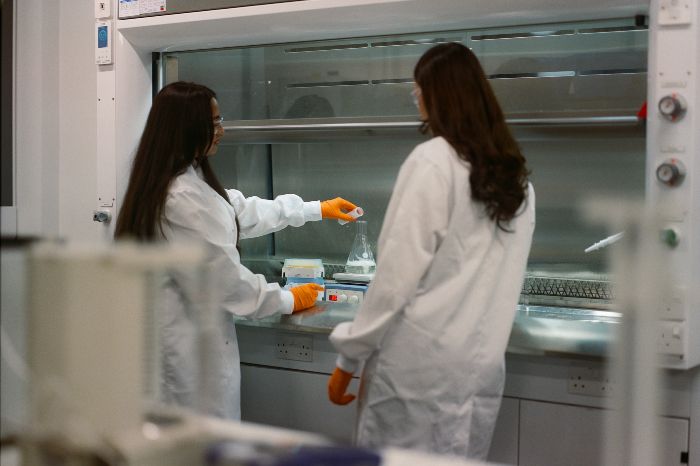
LanthaGen Bio is developing a sustainable approach to recovering rare earth materials from waste
Built for early-stage innovation
For early-stage entrepreneurs, traditional research grants can lack the fluidity needed in fast-moving start-up environments, where priorities can shift rapidly.
As Alexander explains: “You write a grant and then it’s almost as if it’s set in stone. You can only use a certain amount for travel, a certain amount for consumables, a certain amount for people.”
Niaz echoes this: “Half the time is spent managing the funds rather than actually doing the work.” Grants often require upfront financing too, something most early-stage entrepreneurs simply don’t have.
As Sahara points out: “If you don’t have those funds available, you have to go through debt financing and that’s just not an option. It’s a blocker to social mobility.” Ideas with Impact takes a different approach. By offering winners flexible funding with no upfront financial burden, it allows them to be agile, adapt quickly to challenges and focus on developing their ideas.
Everything started with Ideas with Impact. It was the catalyst that allowed us to implement our vision.
From ideas to impact
For all three founders, the impact of the awards has been immediate. For Sahara, the award marked a turning point for LanthaGen Bio: “Everything started with Ideas with Impact. It was the catalyst that allowed us to implement our vision.”
And it’s clear she’s right. In the year since winning the award, LanthaGen Bio has seen monumental growth, transforming from three founders balancing the project around their jobs and study into a company employing six people full time. The team found the award gave them the credibility needed to approach desired funders and partners, enabling them to multiply their original proof-of-concept funding 18 times through subsequent investments, grants and partnerships.
At Imprinted Diagnostics, the funding enabled the team to think bigger. As Alexander explains: “Ideas with Impact gave me the confidence, the gall, to go after bigger funding.” Since receiving the award, the company has secured more than £400,000 in follow-on funding, employed a Vice President of Engineering and accelerated their prototype development, working closely with NHS trusts to prepare a market-viable product at speed.
For Niaz at SporeSense, the biggest impact of the funding was the increase in speed: “If we hadn’t had that funding and the flexibility it provided, we’d have missed out on a year of trials data.”
The funding allowed the team to work fast, leading to 15 devices being built and deployed across four farms in time for crucial points in the farming cycle, attracting significant interest from across the agricultural sector.
Looking ahead
This is just the beginning for these start-ups. LanthaGen Bio is now progressing through an international three-year competition worth up to £6 million in equity-free funding. Imprinted Diagnostics is moving rapidly towards clinical validation, with a £1.9 million funding bid underway, supported by a growing network of NHS partners. Meanwhile, SporeSense is preparing to spin out by the end of the year, scaling manufacturing and moving towards commercialisation.
This rapid growth demonstrates the powerful launch pad that targeted early-stage funding can make for young start-ups, turning their promising ideas into viable businesses with impact. As Professor Aline Miller, Manchester’s Associate Vice President for Enterprise, explains: “The innovation ecosystem across the University and beyond is thriving and this is an incredibly exciting time to turn ideas into reality.
“At Manchester, our aim is to make entrepreneurship part of everyday life for the entire University community, enabling us to drive inclusive economic growth for our region and beyond.”
Ideas with Impact forms part of our wider innovation strategy, supported by Challenge Accepted. Through the programme, supporters are helping to build one of Europe’s most inclusive and impactful innovation networks, fuelling ideas that become solutions and progress that changes lives.