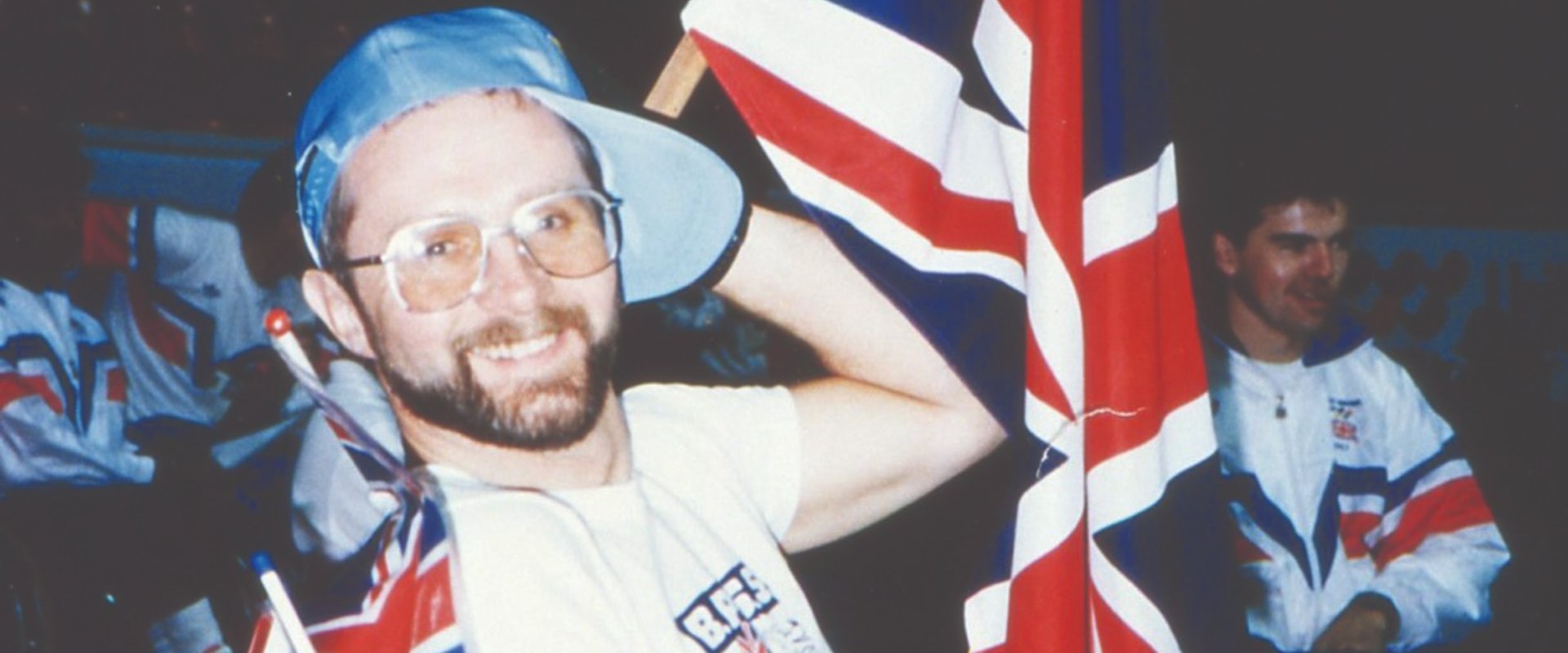
Sir Philip Craven’s remarkable journey from rock-climbing accident to Paralympic glory and global Para sports advocacy highlights his resilience and dedication. His formative years at Manchester proved pivotal – both on and off the basketball court.
As his picture jerks and sound slows, our connection is lost – and I fear my interview with Sir Philip Craven MBE has reached an impromptu end. But within seconds he reappears on screen, picture restored, having – he explains – immediately fixed the issue with his WiFi.
It soon becomes apparent that Sir Philip, decorated Paralympian, global Para sports advocate and Manchester alumnus, always responds to adversity, big or small, with action.
Practice makes perfect
It’s a mindset that has defined much of his life.
Having lost the use of his legs following a rock-climbing accident aged 16, Sir Philip – who graduated from Manchester with a bachelor’s degree in Geography in 1972 – would go on to become one of the all-time greats in wheelchair basketball, representing Great Britain (GB) at five Paralympic Games before serving as President of the International Paralympic Committee (IPC), overseeing eight Games between 2001 and 2017.
And his time at Manchester, I discover, set the ball rolling…
“Definitely, without The University of Manchester and university life, I wouldn’t have become the player I was. And that opened all sorts of doors for me."
Alongside his studies and competitive matches at weekends, Sir Philip would train at the University throughout the week. “I could just go down to the gym and practise all the skills and they came on relatively quickly. By the end of those three years, I was already one of the best players – maybe – in the world.”
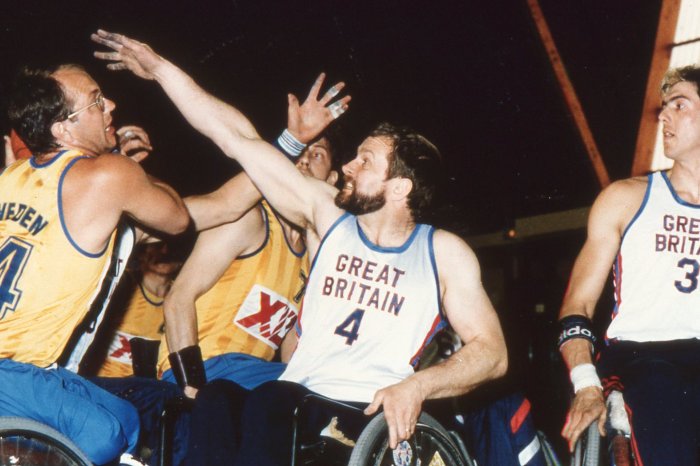
Sir Philip Craven competing in the 1987 European Championships versus Sweden
I got a first-class honours in wheelchair basketball – that’s how I put it.
In transition
But the confidence and determination that shaped his years at Manchester began much earlier. While lying on his back in a hospital bed in Southport, three days after his accident, Sir Philip, a keen young sportsman from Bolton who loved cricket and football, remembers wheelchair basketball being played outside his window. “I saw it and something just clicked subconsciously. ‘Well, you can still play sport’."
Not only would he play; he’d thrive. At Manchester he discovered the McDougall Centre – a University sports hall where he’d spend three hours a day playing basketball and an hour swimming, despite the pool being upstairs. “Every day, two or three guys would get me up the stairs and I’d do the swimming and come down."
Basketball, though, was the sport he enjoyed – and excelled at – most. “I was pretty ruthless and a bit like [former football player] Roy Keane, maybe.” He trained with the University’s stand-up basketball team – national champions at the time, with players from all over the world.
“Without having three years at Manchester that I could devote to getting better at the sport, it would not have been possible. I got on great there, I had a lot of friends and had a very good time."
Taking a charge
His time at Manchester would steer the course of his early life, both professionally and personally.
In 1969 he was selected as a future hopeful for the GB wheelchair basketball team and would remain part of it until retiring in 1988. In 1971 his talents were noticed at the International Stoke Mandeville Games where, he recalls, “the whole of the French team came down to watch me shoot and train”.
Later that year GB won the European Championships, beating France in the final in front of 2,000 spectators.
Sir Philip graduated in 1972 and in the same year competed in his first Paralympic Games, before being approached by a French wheelchair basketball club with a ready-made contract. After some difficulties being deemed ‘fit to work’ – despite, he asserts, being “one of the fittest people in Britain at the time” – he was ready to go.
What began with basketball soon became more personal. “On the second day there, I immediately fell in love.”
Teams start with two
Sir Philip’s future wife, Jocelyne, was part of the club’s physiotherapy department and, after a six-month on-off relationship, the pair reconnected following GB’s defeat of France in the final of the first-ever Wheelchair Basketball World Championship in 1973.
Jocelyne was official physio to the French team and the couple “got together at the party that night – and we’ve never been apart since”.
They would form a formidable team. “Something I realised about 20 years ago is that teams start with two. Really true friends, you can tell them anything and exchange ideas. You can go through brick walls.
“If there’s two of you, you can’t go wrong. And the opposition will find that pretty tough."
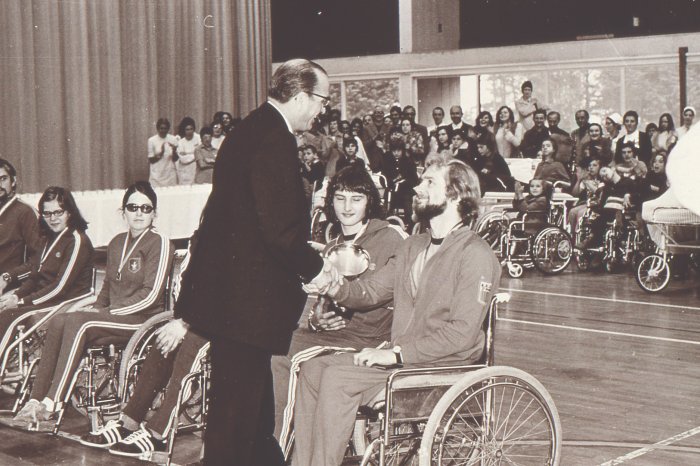
Sir Philip receiving another accolade during his illustrious playing career
Don’t pass it up
During his early playing career in France, Sir Philip took the opportunity to learn the language – something that would later prove invaluable. “If I hadn’t spoken French, I wouldn’t have been elected President of the IPC.” His career – both as a player and renowned sports administrator – would take him around the globe, meeting world leaders along the way.
Recently, Sir Philip was honoured at the University’s Sport Awards and XXI Club Dinner – a club founded in 1932 to celebrate elite sporting achievement at Manchester, and which supports UoM Sport to this day.
More than five decades after graduating, his connection to the site of those defining years remains strong. “It’s good to come back to the University,” he says, smiling.
“My heart’s very warm for Manchester, you know.”
Find out how you can support student inclusion and success at Manchester.