



Manchester, UK,
19
October
2026
|
08:00
Europe/London
What happens when we bring creative reflection to everyday inequalities?
Ideas at Work explores how humanities research creates change in the world around us. This story follows how research on poverty and social justice is helping shape conversations, policy and support for those experiencing hardship.
Ideas at Work title banner
Graphic with Ideas at Work and Faculty of Humanities stated on it. A background image of arts and craft supplies. Foreground image of a journal which has been chewed on my a dog and scribbled on the cover with a flower and love heart.
At a glance
Research team
Discipline
School of Arts, Languages and Cultures
Department of Religions and Theology
Partners
Poverty Truth Community (Glasgow)
Poverty Truth Community (Greater Manchester)
The question: What happens when we bring creative reflection to everyday inequalities?
Inequalities are often separated by different categories, whether in policy and government, or in research areas. Housing as different from mental health. Food poverty as different from children’s wellbeing. Asylum and disability as different again.
This can mean that the complexity of people’s lives is reduced to an issue, rather than seeing how various inequalities show up in people’s daily experiences. Equally it can ignore what people have already been doing to navigate these concerns, care for their community, and create wider change.
These issues were at the forefront of The Embodied Everyday project that asked what would happen if the research project was based on people exploring their everyday experiences together, with space to support creativity and conversation.
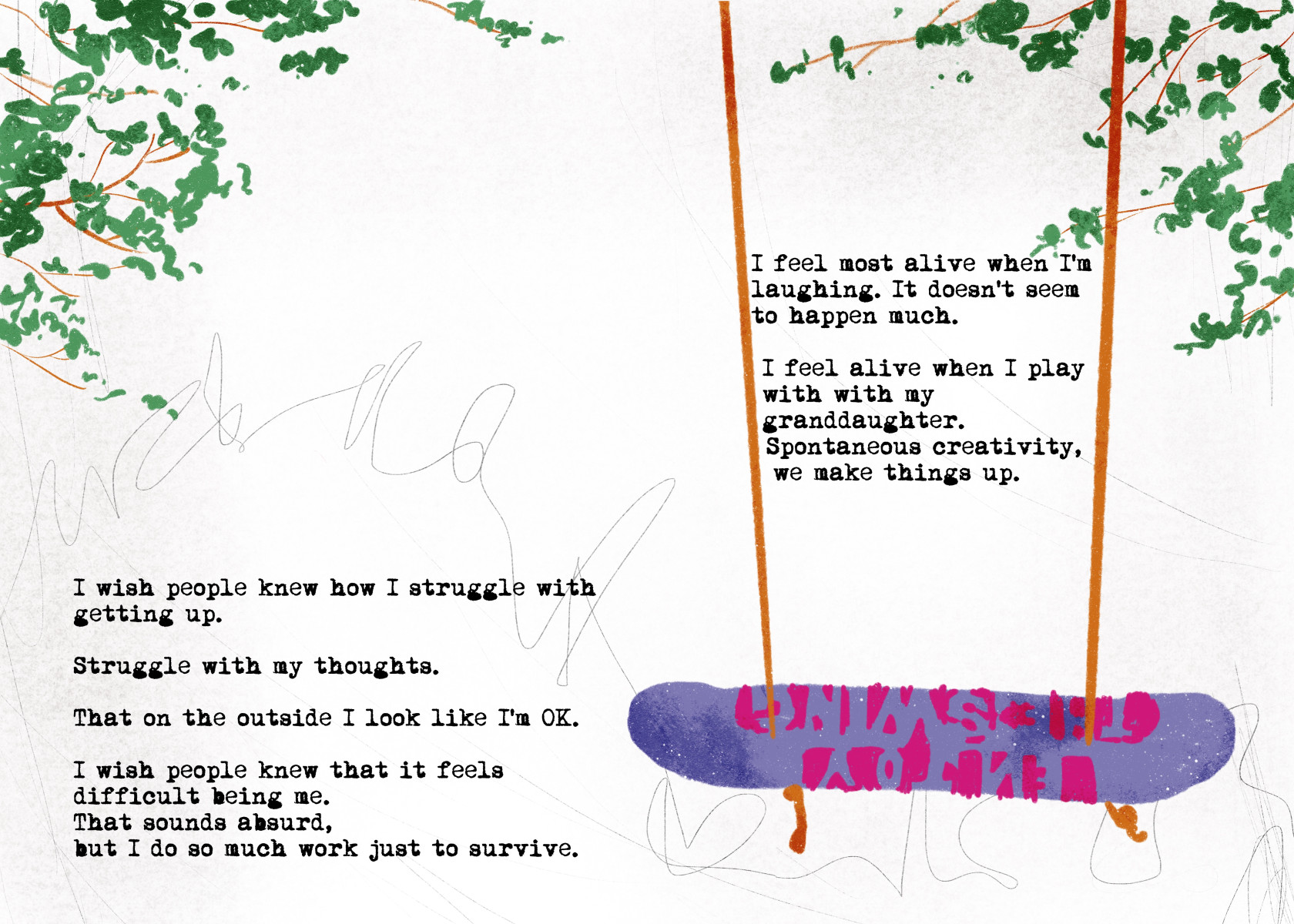
Swing graphic from Filled to the Brim
Double page spread on a white background. Green leaves on braches on the left and right corners of the pages. A purple sswing with pink overlay is on the right page. Text on the page: 'I wish people knew how i struggle with getting up. Struggle with my thoughts. That on the outside I look like I'm OK. I wish people knew that it feels difficult being me. That sounds absurd, but i do so much work just to survive. I feel most alive when I'm laughing. It doesn't seem to happen much. I feel alive when i play with my granddaughter. Spontaneous creativity, we make things up.'
The idea
Working with members of Poverty Truth groups in Greater Manchester and Glasgow, the project examined how issues such as poverty, housing, disability, racism and mental health are often treated separately, even though they are deeply connected in people's everyday lives.
The project began with four ‘steering group’ sessions, led by Dr Radford and participants from different Poverty Truth groups, to ensure the project was designed in collaboration with people taking part. The steering group considered what questions were important to shape the research and how people wanted to take part.
As this took place during the COVID-19 pandemic lockdown, the steering group had to think carefully about access and energy levels. As well, the steering group considered whether responding to creative prompts in a group on a video call would be a good way to work together. In experimenting with these questions, the steering group tried out different approaches, before settling on sending people creative journalling packs with prompts, and inviting people to take part in online reflective group workshops.
Participants took part in reflective workshops and kept creative journals using writing, drawing, collage, photography and voice recordings. These humanities-based methods enabled people to express experiencesand understandings that might be difficult to capture through more traditional research approaches, resulting in the public-facing digital resource, Filled to the Brim.
“
There’s a lot of critique of what we would call ‘damaged-centred research’, which focuses on problems and issues rather than looking at the whole person- as someone who experiences multiple things in any one day and is capable of feeling multiple emotions... I think that’s something that comes through in Filled to the Brim. Yes, there are pages that contain very sensitive and difficult experiences, but there are also pages where people talk about having fun and feeling hopeful. There’s got to be space for all of that in the research project.
Dr Wren Radford, Lecturer in Liberal Arts
„

The creative reflective research
The research created opportunities for participants' experiences to inform wider conversations about inequality. For more than a decade, Poverty Truth Commissions across the UK have asked: ‘What if people who struggled against poverty were involved in making decisions about tackling poverty?’
The project started with weekly sessions of online reflective workshops, with people using their creative journal at times that suited them. They could write, draw, collage, use photographs, doodle, and also send voice notes. The project emphasised that creativity comes in lots of different forms and particularly thought about ‘everyday’ forms of creativity that are often overlooked, including cooking, playing, and imagining together if the world could be different.
The materials from the workshops and in the journals reflected how people make meaning in different ways in their lives, the responses were very specific to each individual but also showed the sense of community in listening to and supporting one another.
“
I’ve actually been using it again, and I think, again, it’s helped me cope. So, to me, I think this should be rolled out as a project, because, as I say, it’s made such a difference to my life, and I would have been the biggest sceptic to start with, saying, 'Oh aye, writing down things and drawing things, that won’t do ’, but as I said, it’s changed my life, and I'm going to carry on doing it.
Anonymous participant, Filled to the Brim
„

Filledtothebrimexcerpt
Double page spread on a white background. On the left hand page there is a series of stacked boxes in dark grey and black, they roughly form a grid, but are not neat, they sit at slightly off angles to each other. On some of the boxes there are words, which form the phrase: ‘today I feel as if I will never get out of the bleak box of poverty, always trapped, no escape.’ The boxes in the bottom line start to fall out of the grid, leading to a larger box escaping from the grid that reads ‘but on good days…’ This forms the bottom of a random stack of brightly coloured boxes set at playful angles to each other on the right-hand page. A red box reads: book club on zoom’. A purple box has the word ‘hope’. It overlaps with the pink box that has the text on it: ‘phoning friends I’ve made through these groups to chat and laugh and cheer each other up’. A green box in the centre of the page reads ‘challenging’. A turquoise box has the text: ‘being involved in food justice movements’. It overlaps with and orange box that reads ‘uplifting’. A large pink box reads: consultation on disability benefits – disabled people know what’s best for them’. A dark green box has the text: ‘reply from my MSPs, hope in future’. A red box has the text: ‘women’s drop in and support service’.
From research to impact
The project's creative reflection approach created space for everyday insights that are often overlooked in traditional research. Central to this work were long-standing humanities questions like ‘Whose knowledge?’ or ‘What kind of knowledge?’. By working collaboratively with participants, the research challenged assumptions about knowledge and power, encouraging audiences to reconsider how lived experience is recognised and understood.
Filled to the Brim notes that listening to lived experience is not a one-off event. It requires recognising the thoughtful work communities put in to reflect on and share their experiences, and not losing that context. As Filled to the Brim states:
“We can’t be summarised or understood completely in these pages. We keep living, changing, creating, reshaping our worlds. We encourage you to keep listening to and with people who are most impacted by inequalities in our society”
Through ongoing dialogue with participants, the project developed a creative output that reflected the richness and individuality of their experiences. Rather than categorising stories into predefined themes, the digital collection presents journal pages, workshop responses and creative works that capture the complexity of everyday life and the ingenuity people draw upon in response to inequality. The collection takes its name from a poem written by a participant.
Since its publication, Filled to the Brim has continued to extend the reach of the research, sparking conversations about how inequality is understood and addressed. It invites audiences to consider a different starting point: what becomes possible when we move beyond categorising experiences and instead centre people's knowledge, creativity and lived realities?
The difference it made
- Creating space for reflection and connection: Participants reported that combining creative journalling with small-group workshops helped them reflect on their own experiences while learning from people with different backgrounds and perspectives. The process created opportunities for personal reflection, connection and solidarity across diverse experiences of inequality.
- Changing research practice: The project demonstrated how collaborative research can move beyond extractive approaches that simply collect people's stories. Participants were involved in shaping the research and deciding on outputs, helping to establish a model of co-produced research that values community knowledge and creativity. Dr Radford has highlighted how steering groups and collaborative design processes have subsequently influenced their wider approach to research practice.
- Broadening public understanding of inequality: Filled to the Brim challenged narrow discussions of poverty by showing how housing, health, discrimination, care, belonging and everyday survival are interconnected. By sharing participants' creative reflections through a publicly accessible digital resource, the project has encouraged richer public conversations about inequality, lived experience and social change.
download
Ideas at Work
Filled to the Brim shows how humanities research creates change by starting with people's lived experiences. Through creative collaboration with communities, the project generated new understanding of inequality while giving participants meaningful opportunities to reflect, connect and share their experiences. The result is research that not only advances our academic knowledge, but also strengthens public understanding, informing more inclusive ways of working and amplifying voices that are too often overlooked.