



28
October
2026
|
08:56
Europe/London
OASPA 2026
From the article to the answer
Last year I was fortunate enough to be sent to Leuven, Belgium, to attend the OASPA (Open Access Scholarly Publishing Association) conference. You can read my reflections in the November 2025 issue of the Open Research Digest. OASPA provides a great opportunity to consider some of the big questions underpinning Open Access, so I was pleased to be able to attend this year’s conference to continue to engage in the conversations. This year the conference moved to Zagreb, Croatia, where the community of publishers, infrastructure providers and librarians gathered to grapple with some old and some emerging challenges to the transition to Open Access.
In this blog post, I’ll highlight a couple of overarching conversations that I noticed recurring throughout the conference, and found most compelling.
Open Access is only the first barrier
The opening keynote panel brought together perspectives from across the world to discuss how open knowledge benefits society. The striking thing about this session was that there wasn’t a great deal of discussion about traditional scholarly publishing. Panel members talked about work they’re doing to go beyond Open Access to remove further barriers to understanding, interpreting and participating in knowledge. One project cited focused on helping women in Tunisia to contribute their expertise and knowledge to Wikimedia, which brought to mind the work being undertaken by 2025-26 Open Research Fellow Guilherme Fians.
This session also chimed with work we’ve previously done in the Library to help researchers reach broader audiences; work that’s underway around enhancing Green Open Access; and our My Research Essentials workshop Communicating your research differently. Basically, Open Access removes just one of a whole series of barriers, and if we want people to benefit from the knowledge we generate at the University, we should be trying to remove the others too.
Open for machines, too
As expected, AI was a pervading theme across the three days of the conference. Sometimes this was as advertised on the programme, but other non-AI related sessions were inevitably pulled in that direction too.
Speakers discussed the many AI-related challenges facing the OASPA community, including who gets credit when models draw on research without citing it; who can afford the tools needed to make use of OA content; and who controls the infrastructure that AI increasingly depends on? For publishers, the pressures are more immediate. AI-assisted writing is driving up submission numbers, which puts further strain on a peer review system that’s already overwhelmed. And there’s a question for both publishers and libraries: what happens to usage metrics, which we use to judge the value of what we pay for, when readers increasingly access knowledge through AI tools rather than by visiting the article itself?
AI also presents us with opportunities and, in a world where consumption of knowledge is switching from the article to the answer, we need to rethink how we make that knowledge available. Repositories and publishers struggle to manage traffic from AI crawlers and tools because their platforms are largely built for human readers. While we’ve worked hard for many years to remove barriers to access for humans, forcing AI tools to use human interfaces creates barriers to access for machines. Making structured OA content available through an MCP server, a standard way of connecting AI tools directly to a data source, would be one way around this. It would give users more accurate, properly cited answers, with a clear breadcrumb trail between the assertion and the source. Aaron Tay has written an informative blog post about what MCP servers could mean for scholarly publishing, if you’re interested in learning more.
Keith Webster from Carnegie Mellon University told the conference that AI makes OA content even more valuable for research, but it also makes closed content more commercially valuable for publishers. We’ve already seen several commercial publishers doing big AI licensing deals over the last couple of years. The work we’re doing at Manchester on Enhanced Green Open Access is looking at how, as an institution, we can make our own open content machine-readable and accessible.
If there was one thread running through the conference, it’s that the question is no longer whether research should be open, but open to whom (or what!), and in what form. That’s a question we’re working on in the Office for Open Research.
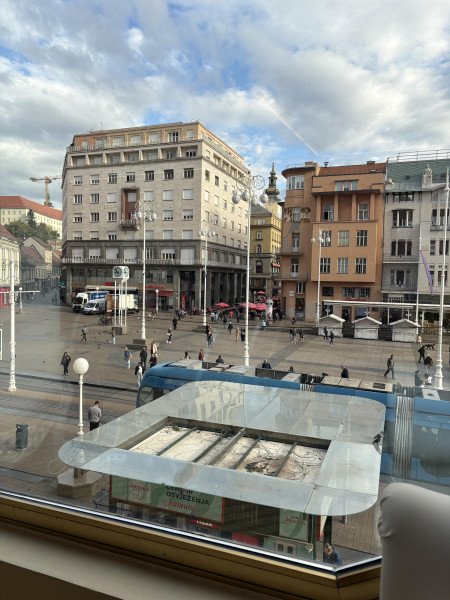
Ps. Zagreb is very nice and I would recommend visiting!
Steve Carlton, Open Research Librarian: Open Access