To mark the 75th anniversary of the Ferranti Mark I installation at The University of Manchester, we look back on how it inspired programmers to push the boundaries of computing and what the future holds.
We all know the story – in 1976 two Steves (Wozniak and Jobs) worked in a California garage to build 50 motherboards that would mark the first step towards computers becoming a mainstay in homes across the world.
And yet this wasn’t the first step. While the Apple-1 is often regarded as the spark that lit the personal computing revolution, the match was struck in 1951 with the world’s first commercial computer: the Ferranti Mark I. And like many of the breakthroughs in computer science, it happened far from the California sunshine, right here in Manchester.
A world first
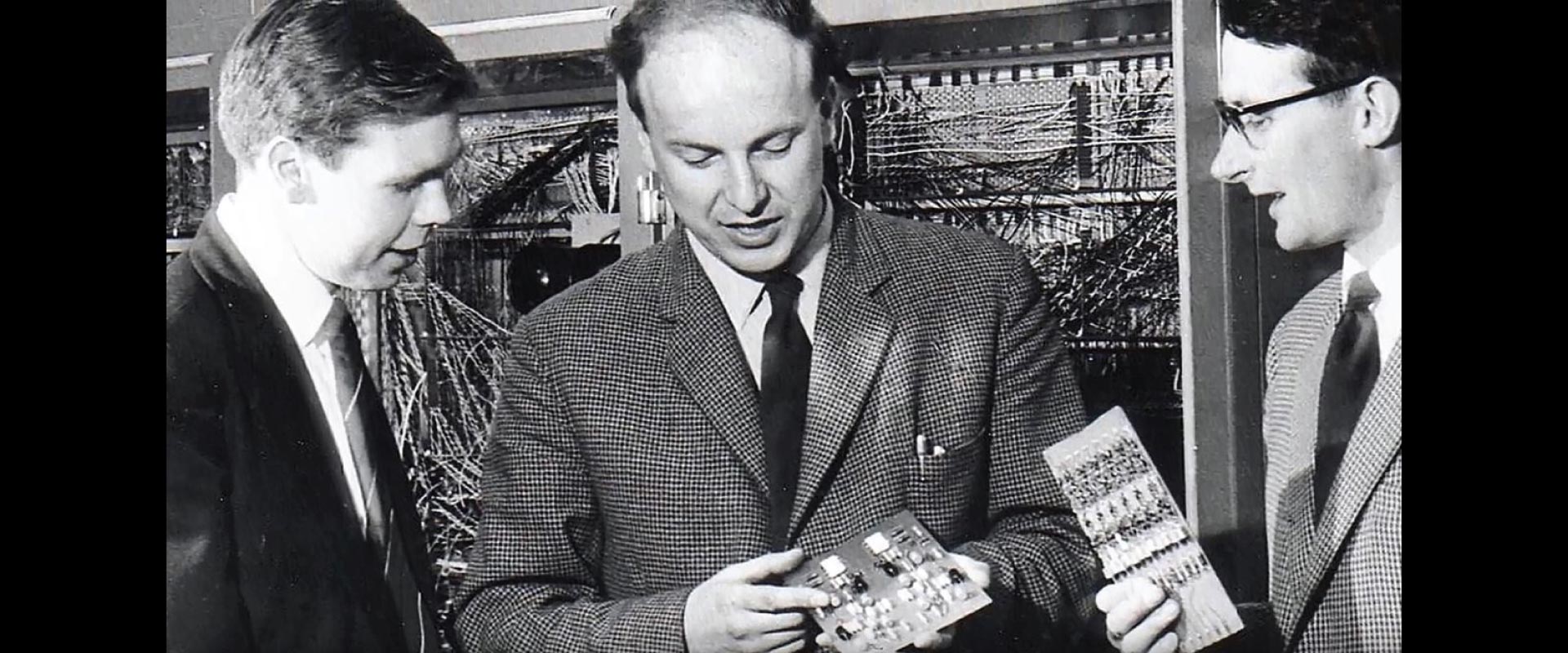
A descendent of the Manchester Baby – the world’s first stored-program computer, built at the Victoria University of Manchester by Freddie Williams, Tom Kilburn and Geoff Tootill – the Ferranti Mark I was the first general purpose stored program computer to be available commercially. Primarily created with mathematical and scientific applications in mind, it was used by government and industry to assist with everything from code breaking to nuclear design.
“The Ferranti Mark I had a huge commercial impact. It was arguably the first computer that someone could buy and use in business, government and science,” says Professor Andrew Stewart, Head of Manchester’s Department of Computer Science. “Up to this point, computers were more akin to research prototypes, proving that the computer concept could work.
“The Mark I was really the start of the computer industry, making the technology more widely accessible – and useful."
It took six months to assemble the Ferranti Mark I ahead of its installation at the University. Built by Ferranti Ltd, founded in 1885 by Sebastian Ziani de Ferranti, the machine put Manchester at the forefront of computing in the UK. In a speech in 1960, Sebastian de Ferranti (grandson of the original Sebastian Ziani) reflected on the impact his company’s machine had as a general-purpose tool in the commercial sector and highlighted its “inherent ability to deal with any problem which can be expressed in numerical or pseudo-numerical form”.
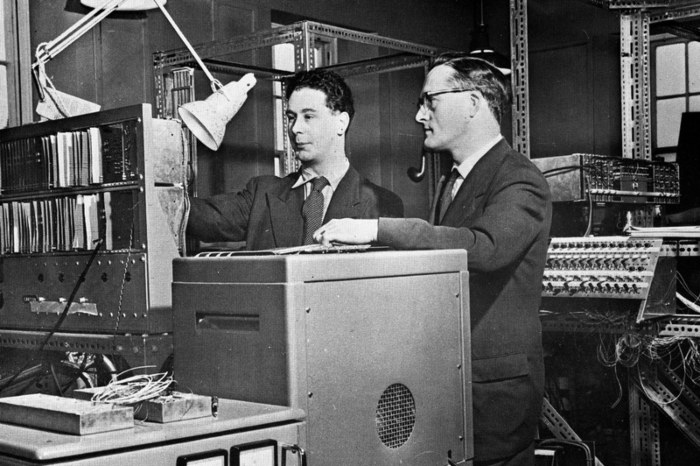
The world’s first commercial computer, the Ferranti Mark I, was built here in Manchester
Partnering for success
University-commercial partnerships were not new. In the 1930s, Douglas Hartree and Arthur Porter’s differential analyser (a mechanical analogue computer) was commercialised by Metropolitan Vickers. Nearly a century on, the University continues to collaborate with industry in its computing research – a recent example being the SpiNNaker supercomputer, modelled on the neural networks of the brain and developed by Professor Steve Furber at Manchester before being commercialised with TU Dresden in Germany.
While SpiNNaker can model spiking neural networks at mouse-brain scale in real time, the Ferranti Mark I’s capabilities were significantly more modest. As Alan Turing wrote: “Electronic computers are intended to carry out any definite rule-of-thumb process which could have been done by a human operator working in a disciplined but unintelligent manner.”
Interestingly Turing, then Deputy Director of the University’s Computing Machine Laboratory, wrote the first edition of the Mark I operating manual. As he noted in the preface, the handbook was written for Mark I programmers rather than as an introduction to computing.
75 years after Ferranti, Manchester is still working on the challenge Turing gave us: creating not just intelligent machines, but ones we can truly trust.
A love letter to computing
At the time of its installation, the computer was used for a range of purposes across the University’s scientific disciplines. The engineers who ran and maintained it soon gained insight into user needs, which would inform further innovations in computer engineering.
Jim Miles, Emeritus Professor and historian at the Department of Computer Science, says: “The people who used the Ferranti Mark I at Manchester discovered new scientific applications such as optics, X-ray crystallography, computational biology and computational mathematics. They also investigated less obvious uses, including games, music and even generative linguistics in the form of love letters."
While turning to an AI chatbot for help with a romantic note may not be unusual today, the very first computer-generated love letter was penned in the 1950s. Christopher Strachey, a teacher at Harrow School and friend of Alan Turing’s who visited Manchester to use the Ferranti Mark I, wrote a program that enabled the machine to generate love letters.
“Darling sweetheart. You are my avid fellow feeling. My affection curiously clings to your passionate wish. My liking yearns for your heart. You are my wistful sympathy: my tender linking. Yours Beautifully, M.U.C. [Manchester University Computer].” Be still our beating hearts. Strachey even programmed the Ferranti Mark I to play music.
Computer gaming, too, is not as recent a pastime as one might assume. In 1952 Strachey developed Checkers, a draughts program that allowed players to compete against an early form of artificial intelligence. The program holds the Guinness World Record for the first ever video game.
Turing’s unfinished challenge
What’s remarkable is the clear throughline from the Ferranti Mark I to computers today – machines that can be utilised for science and research, as well as creativity and entertainment. Says Professor Lucas Cordeiro of the Department of Computer Science: “If the Ferranti Mark I signalled the start of the digital age, the next big step is the era of verified, self-certifying machines. These will include robots, electronic implants, driverless cars and computers that we can trust because they can explain and prove what they will do."
He adds: “As artificial intelligence starts to write its own code, Turing’s question, ‘can we prove that a program does what it’s supposed to do?’ feels more urgent than ever.” Professor Cordeiro predicts the next computing milestone will be to build machines that can prove why they are right: “75 years after Ferranti, Manchester is still working on the challenge Turing gave us: creating not just intelligent machines, but ones we can truly trust."
Calculating, processing, linguistics, music composition, gaming – when it comes to the commercialisation of computers, there’s a lot to thank Manchester for.
Discover how we're shaping AI research and innovation.