



Manchester, UK,
11
November
2026
|
21:11
Europe/London
What a brewery can teach the chemical industry
Many chemicals behind everyday plastics are toxic to the microbes tasked with making them, but a Manchester project is testing a new two-step solution inspired by the brewing industry, with promising early results.
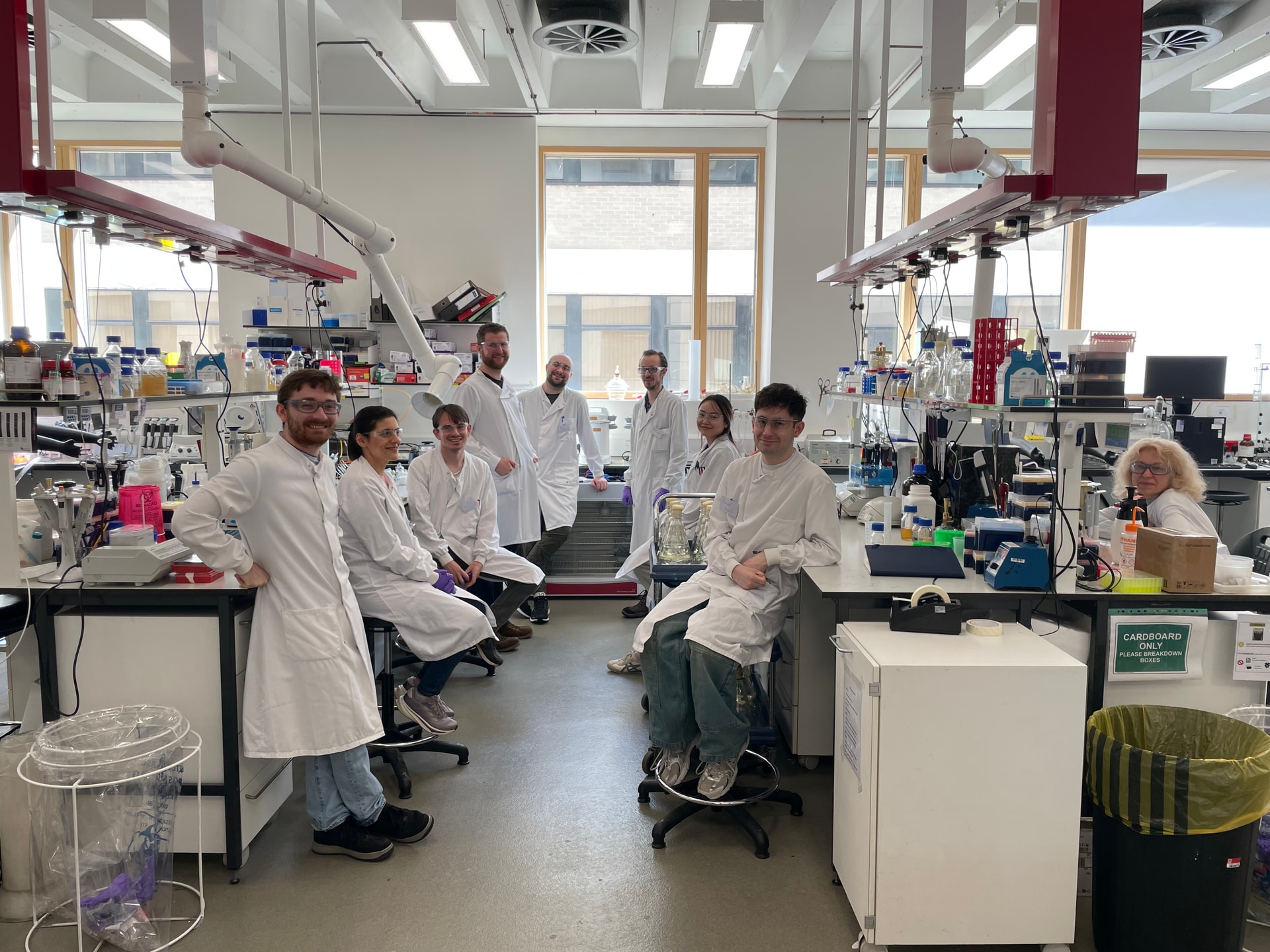
Nine people wearing white lab coats gathered between workbenches in a laboratory containing bottles, glassware and scientific equipment.
Manchester researchers are combining expertise in enzymes, microbes and sustainable processes to test new ways of making commodity chemicals from renewable resources.
What do you do when the chemical you want to make is toxic to the microbe making it? It is a problem that limits efforts to replace oil-based manufacturing with biology, and one that researchers in the Sustainable Commodity Chemicals through Enzyme Engineering and Design project project are approaching by borrowing a principle from brewing.
Take styrene, the starting material for the polystyrene found in food packaging and building insulation. Microbes can be engineered to make it, but in the process, it harms them, limiting how much they can produce. And styrene is not an isolated case: the same challenge faces anyone trying to make the everyday chemicals and materials we need when using biomass rather than oil.
There’s a good reason why it’s a problem the chemical industry wants to solve. Many commodity chemicals – bulk chemicals made in large volumes and sold at low margins, and the ingredients of plastics, lubricants, detergents, fuels, coatings and dyes – are still created from fossil resources, using processes that demand a great deal of energy.
Biology has a good record at the other end of the market, making small quantities of valuable things such as medicines, but the volumes and margins of commodity chemicals mean that any biological process would have to be cheap and robust enough to compete.
A trick borrowed from breweries
The solution might lie in the methods already used by brewers and dairy producers, who work with microbes on a vast scale. Yeast turns sugar into ethanol, the alcohol in beer, while bacteria turn the sugars in milk into lactic acid, which gives yoghurt its tang. Neither compound troubles the microbes that make it, at least at the levels involved, so both can build up to high levels in a tank. Chemists call such compounds biocompatible, meaning living cells can tolerate them.
Now, a team from Manchester think they can borrow that logic to develop a novel approach. Their plan is to split the process into two: in the first step, engineered microbes would feed on renewable raw materials such as agricultural waste and build up a gentle intermediate, a kind of stepping stone. In the second step, engineered enzymes (proteins that speed up chemical reactions) would convert that stepping stone into the final chemical. That way, the microbes never meet the toxic chemical, because growing them and making the chemical happen separately.
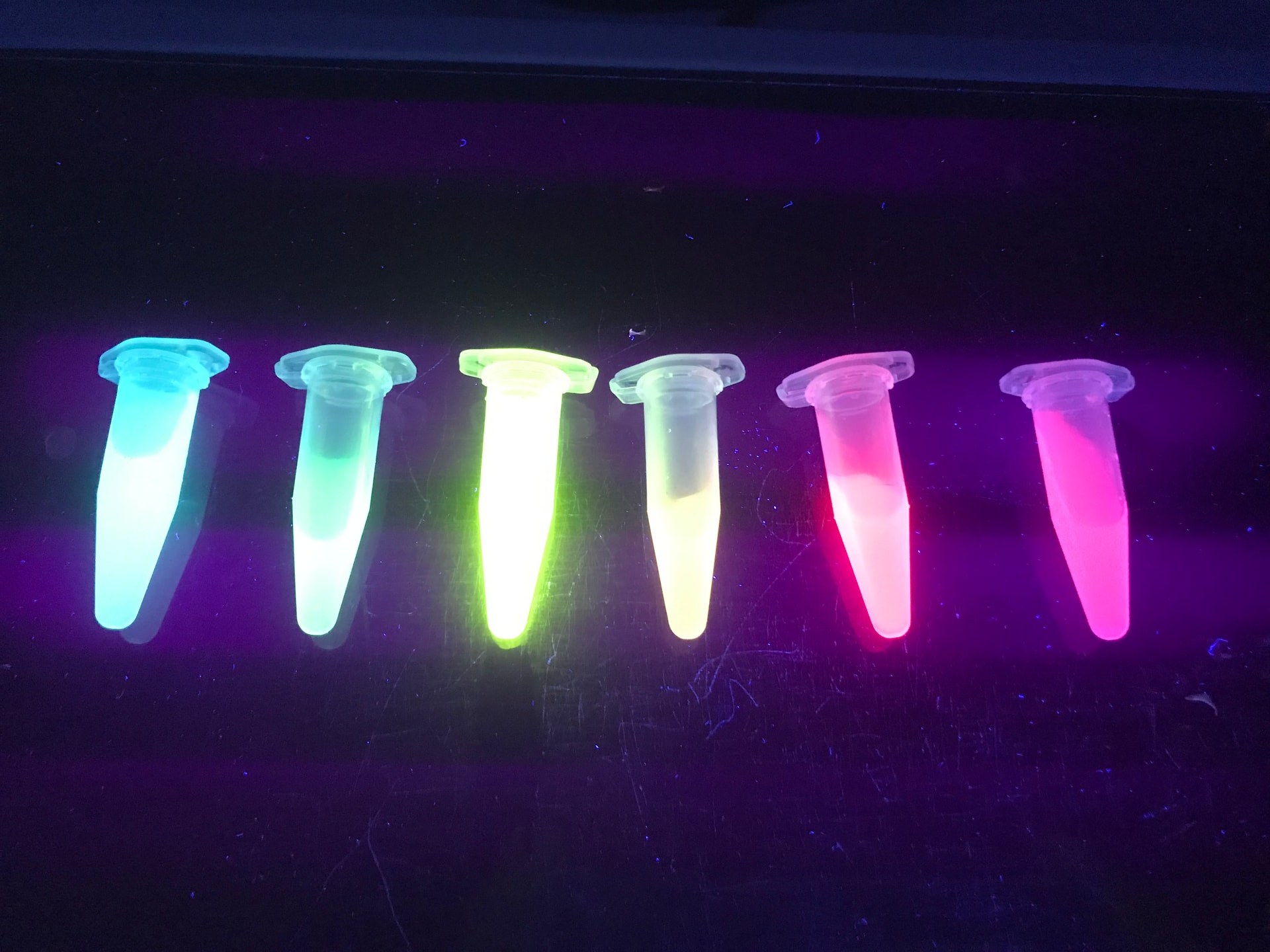
Six small laboratory tubes containing brightly fluorescent blue, green, yellow and pink samples arranged in a row under ultraviolet light.
From changing how proteins behave to developing new routes to everyday chemicals, biomolecule engineering harnesses biology to perform new functions.
Putting the process to the test
In earlier proof-of-principle work the team tested this approach with styrene, which led to a five-fold increase in production compared with previous methods. Other chemicals like alpha-olefins, used to make plastics and synthetic lubricants, and FDCA, a building block for bio-based plastics that could replace those made from oil, are also targets for scale-up.
This research is now at the heart of SuCCEED, short for Sustainable Commodity Chemicals through Enzyme Engineering and Design, a five-year partnership between the Manchester Institute of Biotechnology (MIB) and Shell, which is backed by the UK’s Biotechnology and Biological Sciences Research Council. This Prosperity Partnership scheme pairs university researchers with a company seeking to solve a practical problem, with the idea that technical and commercial barriers can be identified early, before they become expensive surprises.
“
If we can demonstrate an effective route to bio-production, we hope this will be the catalyst for industrial change across the sector.
Jeremy Shears, Royal Society Entrepreneur in Residence at the MIB and previously Shell’s Chief Scientist for Biosciences and former member of the SuCCEED project
„

Eight research groups across the University are involved, led by Professor David Leys, who specialises in finding enzymes and working out what they do. “We’ve previously worked with Shell to discover and characterise new enzymes,” David recalls, “so it was natural for us to partner in tackling sustainable commodity chemical production.”
Fundamental enzyme research, which studies how these molecules work in detail, is one of the MIB’s long-standing strengths. Inside the Institute, the people who explore enzymes work alongside those who engineer microbes and run fermentations, testing the potential cost and scale of processes. Professor Anthony Green, MIB Director, works on designing and evolving enzymes. In his laboratory, an enzyme can be put through repeated rounds of small genetic changes and selection – a little like natural selection – until it is more robust and ready for application.
Their colleague Dr Rosa Cuéllar-Franca brings a different question to the project – is this route really greener? Her life-cycle assessments count the energy, waste and emissions at every stage, from raw material to finished product, so that a new process can be compared honestly with the old one.
As David notes, “we will be unlikely to meet global net zero targets unless we find more sustainable ways to make the chemicals we need for everyday life.”
Next steps at Manchester
SuCCEED is now focused on showing that the approach used for styrene can work at the scale and cost that commodity chemicals demand. Core to this is the development of a proof-of-principle biorefinery. A biorefinery does for biological raw materials what an oil refinery does for oil, turning them into chemicals and fuels.
The toughest obstacle in the project, microbes being poisoned by their own product, already has a promising answer: a process that keeps them away from this dangerous step. Whether that answer holds as production grows towards an industrial scale is what the next few years are about. For an institute that has spent two decades digging into how enzymes work, it’s a chance to find out what they can achieve.
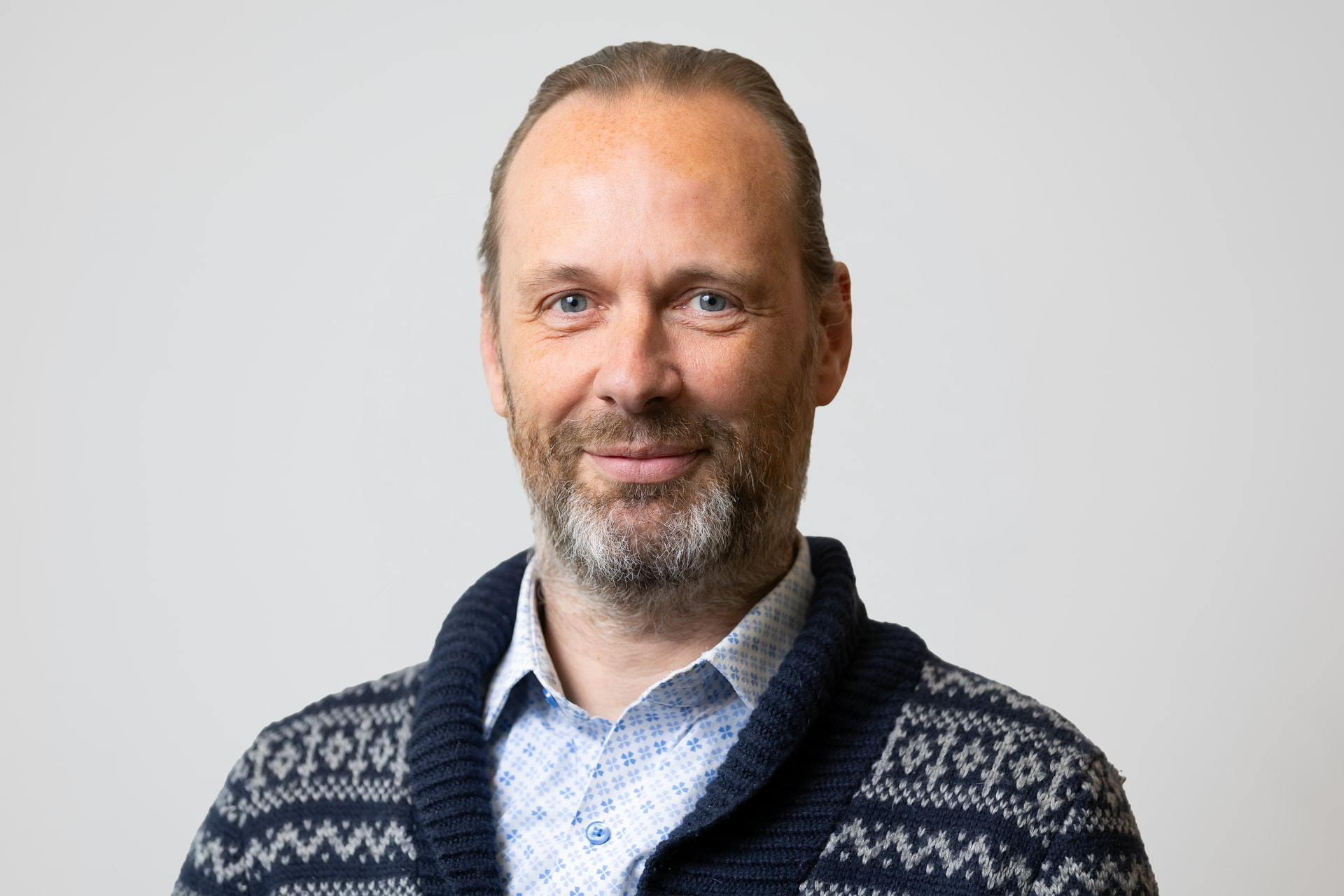
David Leys, Professor of Structural Biology
Meet the researcher
Interested in developing more sustainable ways to make the chemicals we rely on? Connect with Professor David Leys to explore research, industry collaboration and opportunities in sustainable biomanufacturing.