



24
November
2026
|
17:02
Europe/London
Turning society’s waste into sustainable chemicals
Manchester researchers are engineering new ways to recover carbon from complex waste streams and use it as a feedstock for sustainable chemical manufacturing.
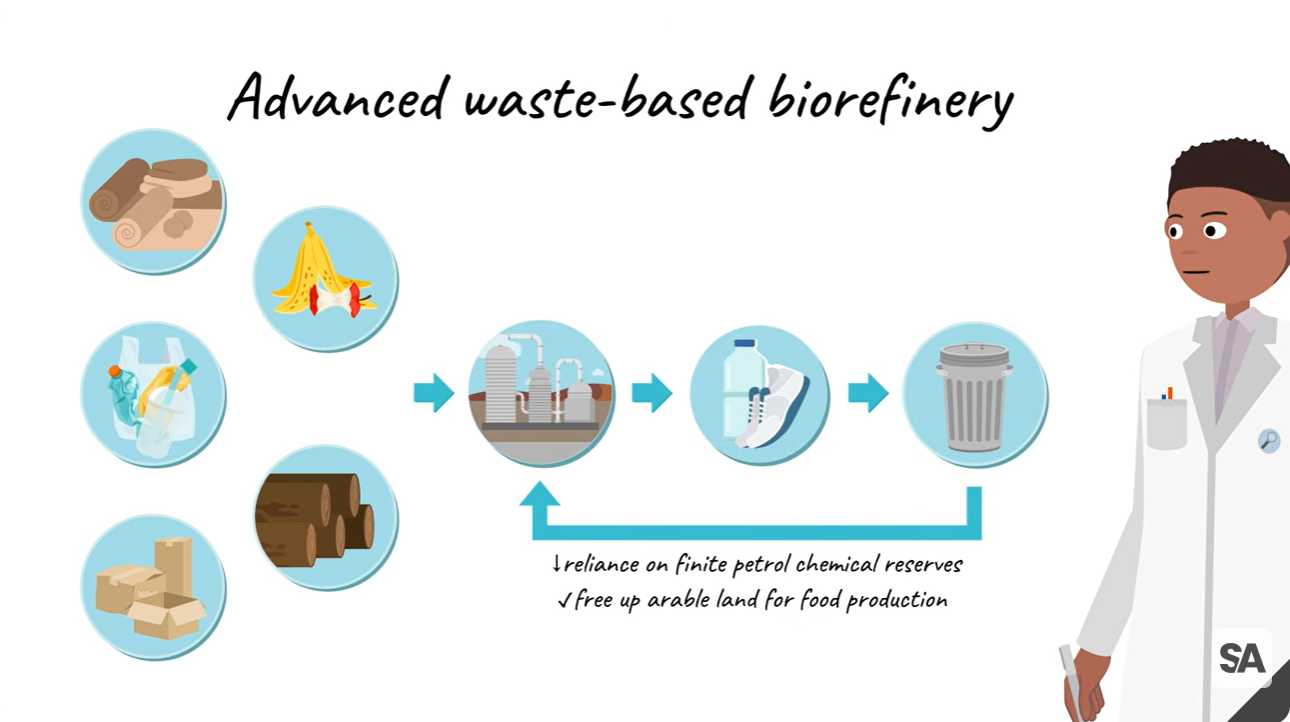
CIRCLE is developing new ways to recover carbon from complex waste streams and return it to productive use as a feedstock for sustainable chemicals and materials.
Diagram of an advanced waste-based biorefinery, showing wood, food, plastic and paper waste converted into useful materials, reducing reliance on finite fossil fuel resources.
Summary
- Modern manufacturing remains heavily dependent on fossil carbon, while valuable carbon is lost through waste.
- The Centre for Innovative Recycling and Circular Economy (CIRCLE) is exploring a transformative model: recovering carbon from industrial gases, plastics and biogenic residues and returning it to productive use.
- Led by Professor Neil Dixon and funded by £2 million from the Biotechnology and Biological Sciences Research Council (BBSRC), the programme has established the foundations for processing mixed waste streams.
- Next, it will integrate microbial conversion with process engineering and test their performance under conditions relevant to industrial deployment.
Recovering carbon from waste
Today, much of the carbon used by industry comes from fossil resources.
At the same time, carbon-rich materials such as agricultural residues, food and paper waste, discarded plastics and industrial gases are lost, burned or released into the environment.
Together, these practices mean we continue to extract new fossil carbon while wasting carbon that is already in circulation.
To address this, the Centre for Innovative Recycling and Circular Economy (CIRCLE) is exploring how carbon contained in waste could become a raw material for making useful chemicals and materials. The aim is to create practical routes towards a more circular manufacturing economy.
The challenge is that real waste streams are heterogeneous. Their composition varies by source, location and processing history, making biological conversion difficult to predict.
CIRCLE brings together biology, chemistry and engineering to develop technologies that can work with this complexity and establish waste carbon as a viable feedstock for manufacturing.
Designing for real-world scale
CIRCLE launched in 2024 with £2 million from the Biotechnology and Biological Sciences Research Council (BBSRC), as part of an $82 million programme led by the US National Science Foundation to support ambitious international research.
Across the partnership, researchers are discovering and engineering enzymes and microorganisms that can tolerate complex feedstocks, selectively use mixtures of waste-derived molecules and channel that carbon towards valuable chemical products. Computational modelling, process design and sustainability assessment are embedded throughout, ensuring that promising laboratory advances are developed with industrial translation in mind.
The Manchester team is leading work on biogenic waste, drawing on two decades of expertise in engineering microorganisms that can sense and respond to mixed chemical environments. This capability is being used to develop robust microbial systems that can process waste-derived compounds and convert them into high-value chemical building blocks, including precursors for new polymers and materials. Together with partner activities in C1 and plastics recycling, this creates an integrated approach spanning multiple forms of waste carbon.
The programme has already put in place the scientific foundations for processing and biologically consuming mixtures of waste-derived compounds.
Its next phase will connect feedstock deconstruction, microbial conversion and process engineering, while testing how different organisms perform across realistic waste streams and defining the conditions required for future industrial deployment.
“
For twenty years, the MIB has demonstrated the power of bringing biology, chemistry and engineering together to address challenges that no single discipline can solve. CIRCLE extends that approach internationally. Our vision is to move beyond managing waste and instead establish waste carbon as a strategic feedstock for manufacturing the chemicals and materials society needs.
Professor Neil Dixon, Chair in Sustainable Biotechnology
„

Read some papers from this research:
Title: Complex waste stream valorization through combined enzymatic hydrolysis and catabolic assimilation by Pseudomonas putida
Journal: Trends in Biotechnology
DOI: 10.1016/j.tibtech.2024.10.020
Title: Engineered co-culture for consolidated production of phenylpropanoids directly from aromatic-rich biomass
Journal: Bioresource Technology
DOI: 10.1016/j.biortech.2023.129935
Title: Hybrid refinery process turns plant material into industrially important chemical
Journal: Nature
DOI: 10.1038/d41586-026-01586-6
To find out more about the research taking place, visit Professor Neil Dixon’s research page