



Manchester, UK,
11
November
2026
|
21:09
Europe/London
A nose to diagnose: how one woman’s observation helped pave the way for a confirmatory test for Parkinson’s
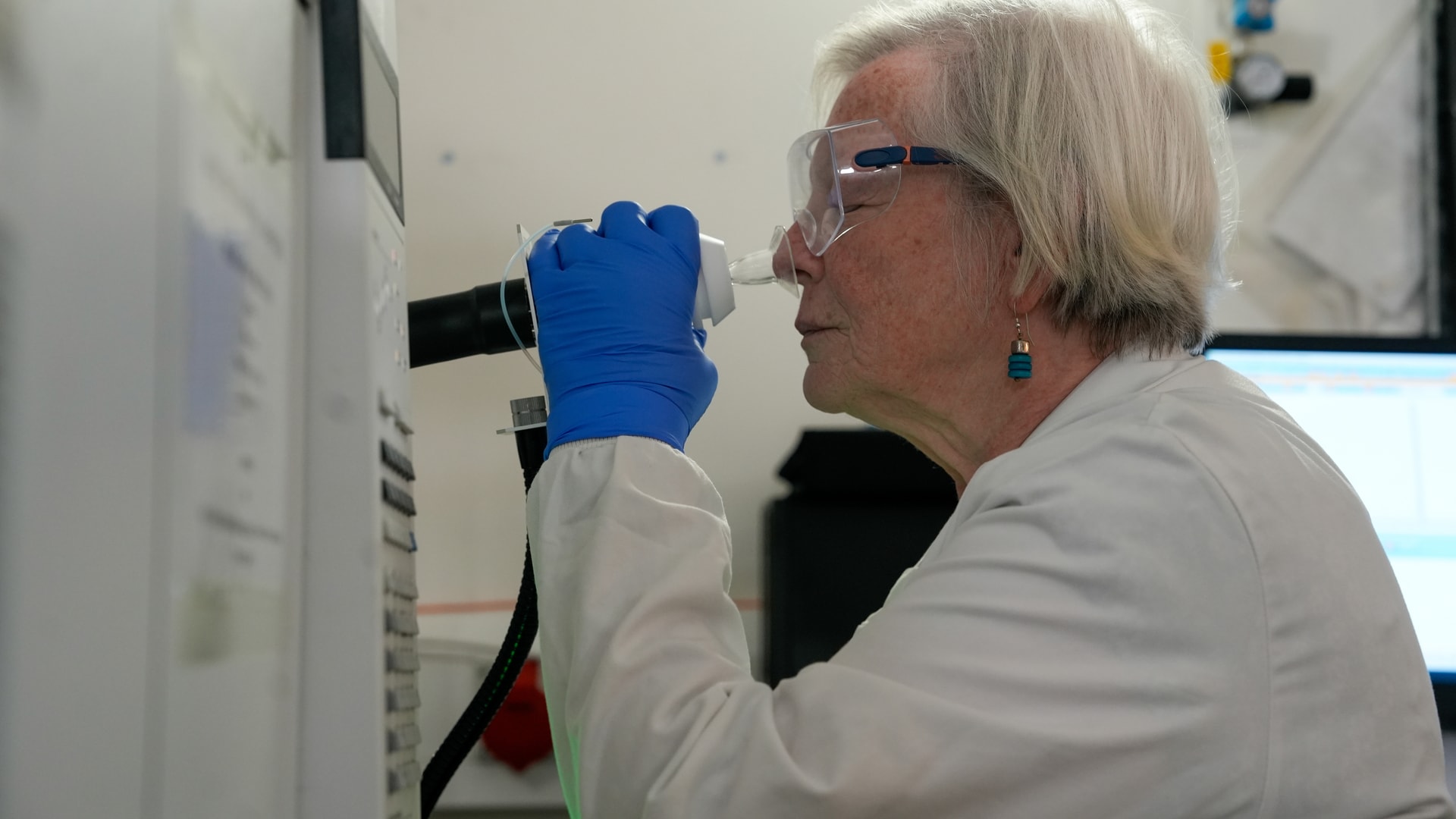
Joy Milne wearing safety glasses and blue gloves, smelling through a funnel-like attachment connected to laboratory equipment.
Joy Milne, whose heightened sense of smell helped inspire research into the molecular signature of Parkinson’s, takes part in research investigating the sense of smell.
A retired nurse who noticed that people with Parkinson’s had a distinct odour inspired Manchester scientists to explore changes in molecules on the skin’s surface. Using a simple skin swab, they can detect around 15,000 molecular features, approximately 10% of which consistently differ in abundance between people with and without Parkinson’s.
“It went from a fairly standard musky-man smell to something stronger and mustier,” Joy Milne recalls of the change in her husband Les’s scent. He was diagnosed with Parkinson’s around 12 years later.
Joy has hyperosmia, a heightened sensitivity to smell. Throughout her career she noticed that people with illnesses smelled differently, but it was at a Parkinson’s support group that it all finally fell into place: “I realised everyone else there had the same scent.”
Joy later went to a talk given by Professor Tilo Kunath, a regenerative neurobiologist at the University of Edinburgh. There she asked him why he wasn’t working to find out why people with Parkinson’s have a distinct odour. Tilo called his collaborator Professor Perdita Barran, a mass spectrometry specialist, and asked if she could help.
“It sounded so extraordinary I didn’t know what to think,” Perdita says. “We tested Joy and she really could smell Parkinson’s.”
A disease that is diagnosed late
Currently, there’s no clinically established molecular test for Parkinson’s. The NICE diagnostic referral pathway relies on movement indicators but the disease can manifest more than 40 symptoms. By the time a patient’s motor symptoms are pronounced enough for them to be referred, up to 70% of their brain’s dopamine-producing nerve cells may have already been lost.
“These symptoms often don’t present until the disease is already well progressed, which obviously limits our treatment options,” notes Perdita. Seeing a specialist – the only route to an official diagnosis – can then take many months.
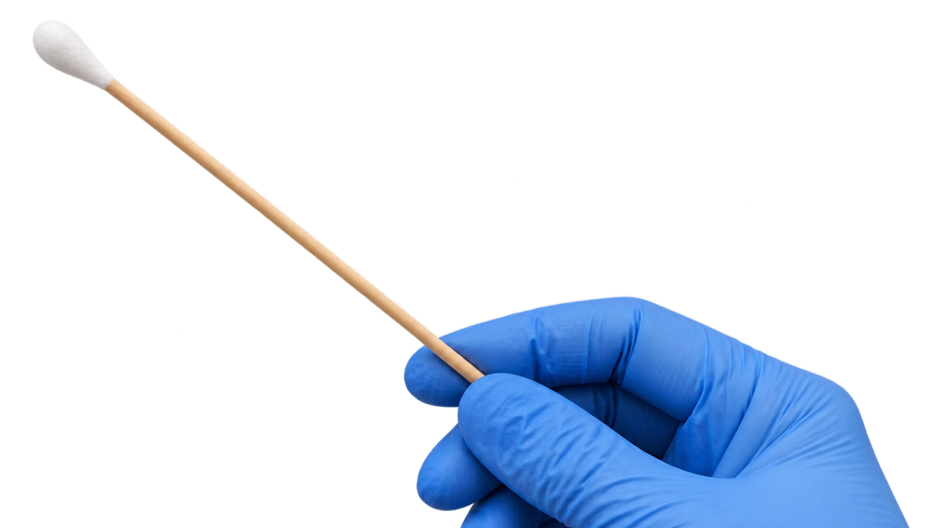
A blue-gloved hand holding a long cotton-tipped swab against a plain background.
A simple skin swab can collect thousands of molecular features from sebum, helping researchers identify a distinctive chemical signature associated with Parkinson's.
Following the nose
The team reasoned that Joy might be detecting metabolic changes that preceded the onset of motor symptoms. In an initial study, people with Parkinson’s and healthy controls wore T-shirts that Joy then assessed without seeing the participants. She correctly identified the Parkinson’s T-shirts and observed that the odour was strongest in sebum-rich areas, including the back of the neck and between the shoulders. Sebum is the oily substance that protects our skin from drying out. Remarkably, Joy also identified a t-shirt from the control group as having the Parkinson’s odour, that individual was later diagnosed with Parkinson’s.
To discover the molecules that were responsible, the researchers used mass spectrometry – a technique that weighs molecules so precisely that it can identify them and also quantify how much of each is present. They teamed up with Professor Monty Silverdale, a neurologist at Salford Royal who helped secure ethical approval for a clinical trial backed by £50,000 from Parkinson’s UK, and later with support from the Michael J. Fox Foundation.
The trial focused on molecular signals collected using simple skin swabs. PhD student Eleanor Sinclair developed methods to extract and measure the molecules using mass spectrometry, while postdoctoral researcher Drupad Trivedi analysed the data. Together they identified a distinct chemical signature of Parkinson’s, including changes in lipid metabolism and essential amino acids. The team has now sampled more than 7,000 participants worldwide, consistently detecting the Parkinson’s signature across different ages, ethnicities and sampling locations. The biomarkers also change as the disease progresses, raising the possibility of using them both for diagnosis and to monitor progression.
“The great thing about moving to the Manchester Institute of Biotechnology (MIB) was it gave me the space to explore this incredible observation, to find the chemical signature of Parkinson’s,” recalls Perdita.
Next steps: from laboratory to clinic
The science has resulted in a spin-out company, SebOMIX, which is now seeking investment for a trial in Greater Manchester. The trial would sample around 400 people with suspected Parkinson’s, referred by their GPs, and another around 400 people with other symptoms such as dementia. The team at the MIB would work with clinical biochemists at Wythenshawe Hospital to analyse the swabs without knowing which was which. If the clinical laboratory can reproduce the research findings, the team will use the results to support the necessary regulatory approval and laboratory accreditation processes involving the MHRA and UKAS.
The hope is that a swab could help to decide who should be referred to a Parkinson’s-only clinic, where patients can receive targeted care from a range of specialists – easing the pressure on waiting lists. If chemical changes can be found before movement symptoms appear, it might also help to identify people who could take part in trials of treatments that aim to protect nerve cells.
For Perdita, who leads the Michael Barber Centre for Collaborative Mass Spectrometry at the MIB, the ultimate goal is clear. “We now want to translate this lab-based diagnostic into something that can be used routinely in clinic to diagnose and better understand this awful condition.”
Joy continues to contribute to Parkinson’s research. She has worked with Parkinson’s UK on training for health and care staff, and with Drupad Trivedi and the Defence Science and Technology Laboratory to understand hyperosmia. She hopes her extraordinary sense of smell will ultimately improve diagnosis and treatment for people with Parkinson’s.

Professor Perdita Barran
Meet the researcher
Professor Barran holds a Chair of Mass Spectrometry in the Department of Chemistry and is the Director of the Michael Barber Centre for Collaborative Mass Spectrometry at the Manchester Institute of Biotechnology.