



Manchester, UK,
12
November
2026
|
10:56
Europe/London
Windows made from vegetables? From potato peel to Plexiglas
Inside an industrial unit in Stockport, a Manchester spinout company is teaching bacteria to turn potato peelings and sugar beet pulp into acrylics and gas. If it works at scale, it could change how everyday plastics are made across the world.
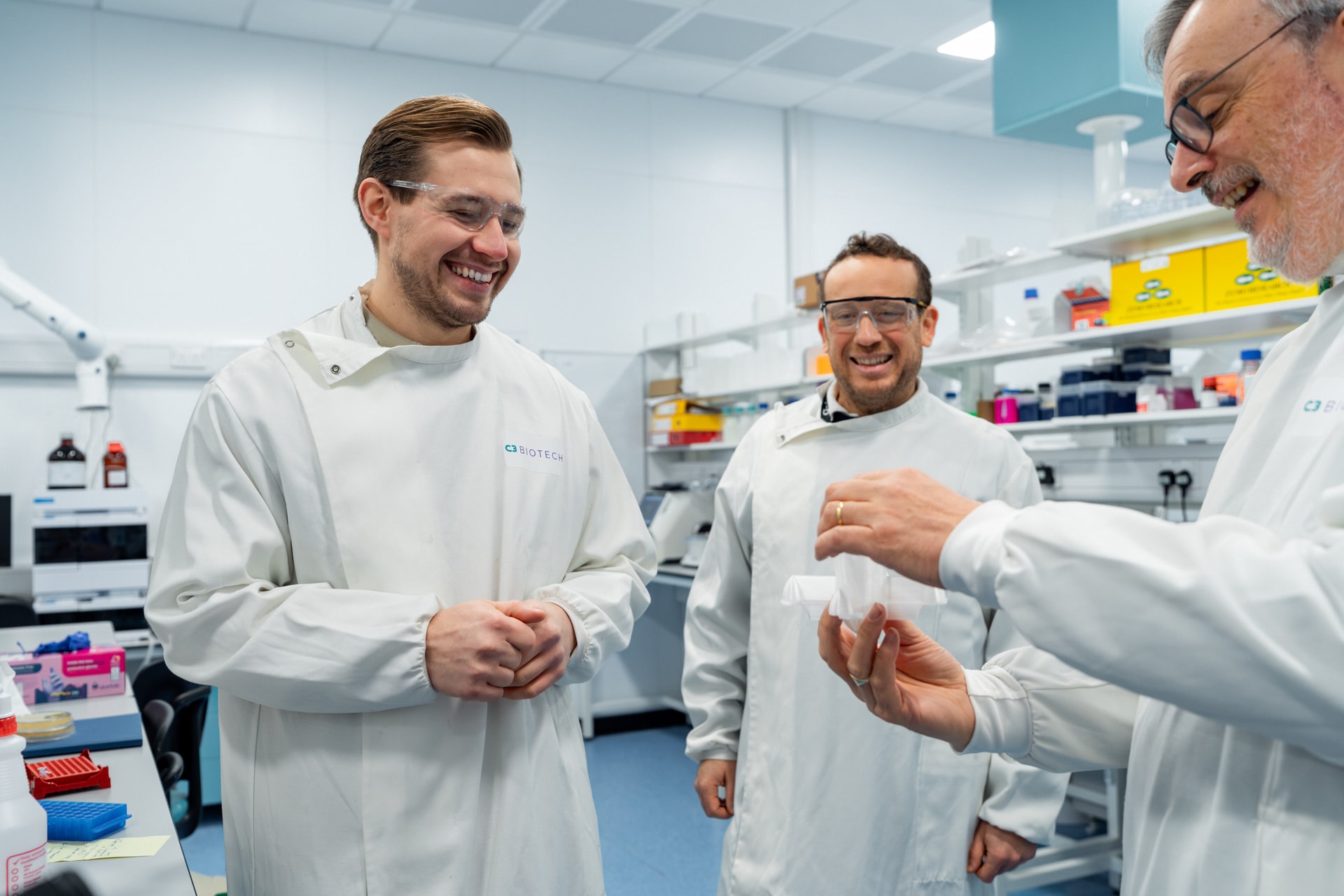
Three people wearing white laboratory coats and safety glasses stand around a laboratory bench, examining a small clear sample container.
C3 Biotech is taking biomanufacturing beyond the laboratory, developing processes that use waste feedstocks to produce the building blocks for everyday plastics.
Picture an aeroplane window, or your bathtub. Now picture a potato peeling. The two might seem like they belong in different worlds, yet inside an industrial unit in Stockport, a colony of bacteria has been quietly closing the gap between them.
Their job is the same as many teenagers: to eat leftovers. Except these aren’t pizza, but potato and sugar beet waste, plus residues from biodiesel production. What the bacteria can produce from this is the raw material for Perspex (or Plexiglas), a tough, glass-like acrylic.
This is not some small experiment in a petri dish; it’s the business of C3 Biotech. Backed by three rounds of multi-million pound funding from SPRIND, Germany’s Federal Agency for Disruptive Innovation, they’ve built a first-of-a-kind pilot plant in Cheshire, a small factory that they have used to prove a process works before building it out at full size.
Why this is trickier than it sounds
Most of the things around us, from paint to packaging, are still made from fossil fuels dug out of the ground. Biology has long promised an alternative: engineering a microorganism to build the same molecules, but from renewable carbon instead. In a laboratory this already works, but keeping it working outside of this environment is another matter.
Feed a microbe pure sugar in a controlled environment and it’ll behave the same way every time, predictable and clean. Real waste refuses to cooperate like that. Potato and sugar beet leftovers change from one batch to the next, carrying different amounts of starch, water and impurities depending on the harvest, the season and even on how the crop was handled on its way to the factory.
Closing that gap, between a process that works once and one that works reliably, hour after hour at an industrial scale, is the whole problem C3 Biotech exists to solve.
Where science meets scale-up
C3 Biotech began in 2015 with a narrower ambition: the biological production of propane. Professor Nigel Scrutton, who’d spent years working at the point where enzyme science meets industrial reality, including a period as Director of Manchester’s Institute of Biotechnology, says his link to the University has never loosened.
“Universities have a broad range of talent, infrastructure and equipment resources that companies like ours need to move projects along,” he notes, “so my team work closely with Manchester on a day-to-day basis.”
“
The point where scale-up gets difficult is exactly where our thinking had to change. Fixing that took chemists, engineers and biologists working through the problem together, in the same place at the same time.
Professor Nigel Scrutton, C3 Biotech's founding director
„

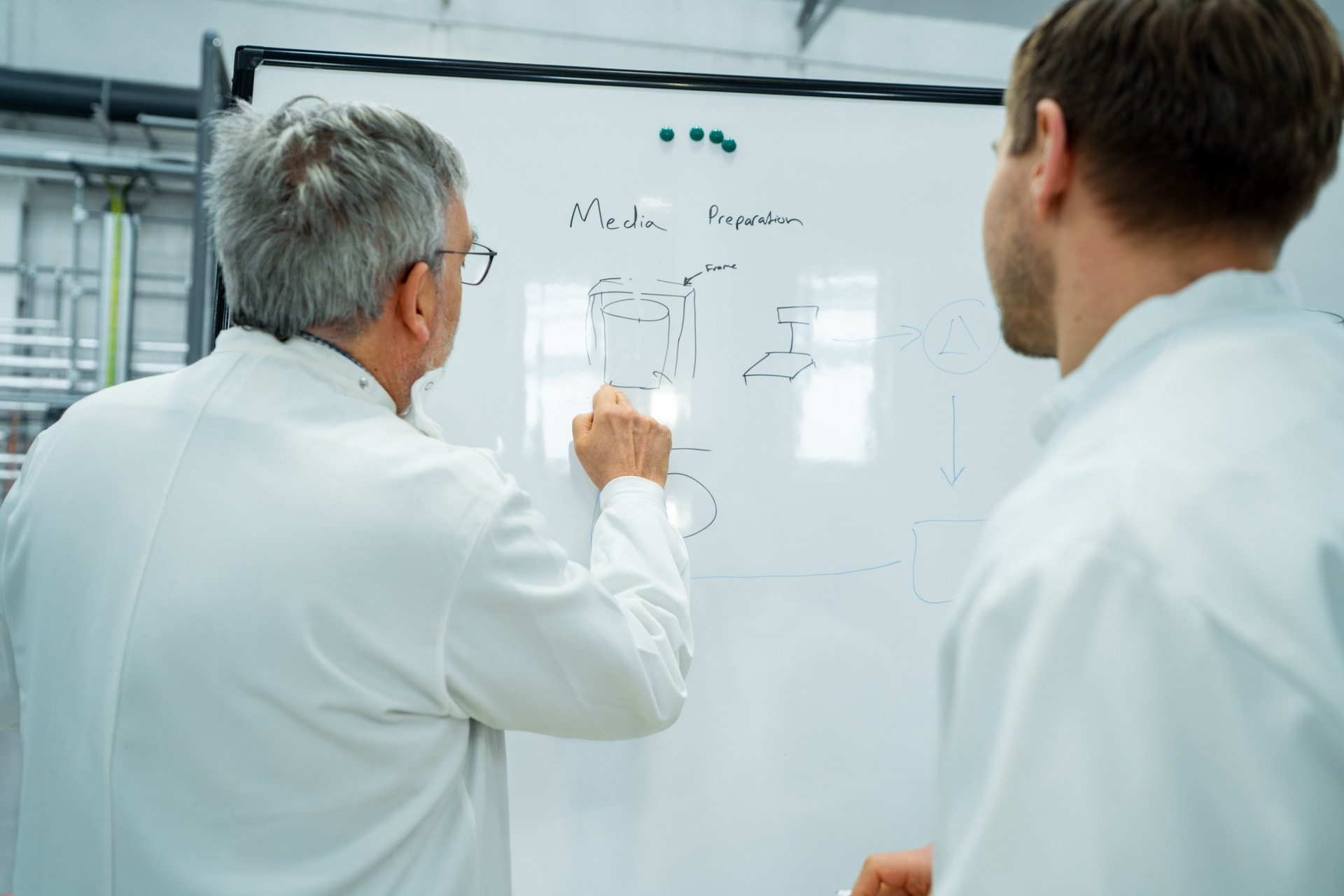
Two people in white laboratory coats stand beside a whiteboard, where one is drawing a process diagram beneath the words “Media Preparation”.
Turning waste into useful chemicals takes more than biology. C3 Biotech brings different disciplines together to develop processes that can make the leap from laboratory to industrial production.
What the Stockport plant has shown
In 2023, C3 Biotech’s acrylics team was one of just eight chosen from more than fifty global applicants for the Circular Biomanufacturing Challenge run by SPRIND. Their test was demanding: build an end-to-end process that runs continuously for 180 days.
Yet the company haven’t just met this target, they’ve gone beyond it. Its pilot plant has run for more than six months without a break and produced more than 100kg of a high-purity intermediate – a molecule which is partway to the finished plastic. That material has then been converted into methyl methacrylate (MMA), the building block of acrylic plastic. By joining these building blocks together into long chains, the team has produced the finished plastic, known as PMMA, which can then be made into everyday products.
Waste has gone in; plastic has come out.
Much of this is thanks to C3’s innovative ways of working. Conventional biomanufacturing takes place in stainless-steel tanks kept scrupulously sterile, which are expensive to build and to run. However, the company’s microbes are engineered to tolerate salt and a messier environment, so its process can run in plastic reactors without sterilised conditions – they can even use seawater rather than fresh water in the fermentation.
This lowers both the costs of building a plant and running it, while breaking the dependence on fossil fuels for acrylic production. C3’s modelling suggests that as a result, bio-based MMA could compete on price with the current oil-based version. Proving this at a commercial scale is their next step.
The company is already establishing manufacturing lines based on the pilot plant’s design and exploring other markets, including the ingredients used in skincare and anti-aging products. Their same approach can also be aimed at fuels, including a biological kerosene designed as an alternative to jet fuel and bio-LPG made from waste biomass and carbon dioxide.
What could actually change
It’s worth reflecting on why this matters beyond the chemistry itself. If it scales, the possibilities here stretch beyond one factory – future manufacturers could turn their own waste by-products into fuels and chemicals rather than paying to dispose of them. Production could happen close to where that waste was produced, with no need to ship in oil. Acrylic precursors created from low-value leftovers, not drilling, could feed plastics, paints, adhesives and textiles.
From potato peelings to the acrylic in our windows: C3 Biotech has moved the science beyond the laboratory and demonstrated sustained operation at pilot scale. The next challenge is proving that it can also become a commercially viable global business.
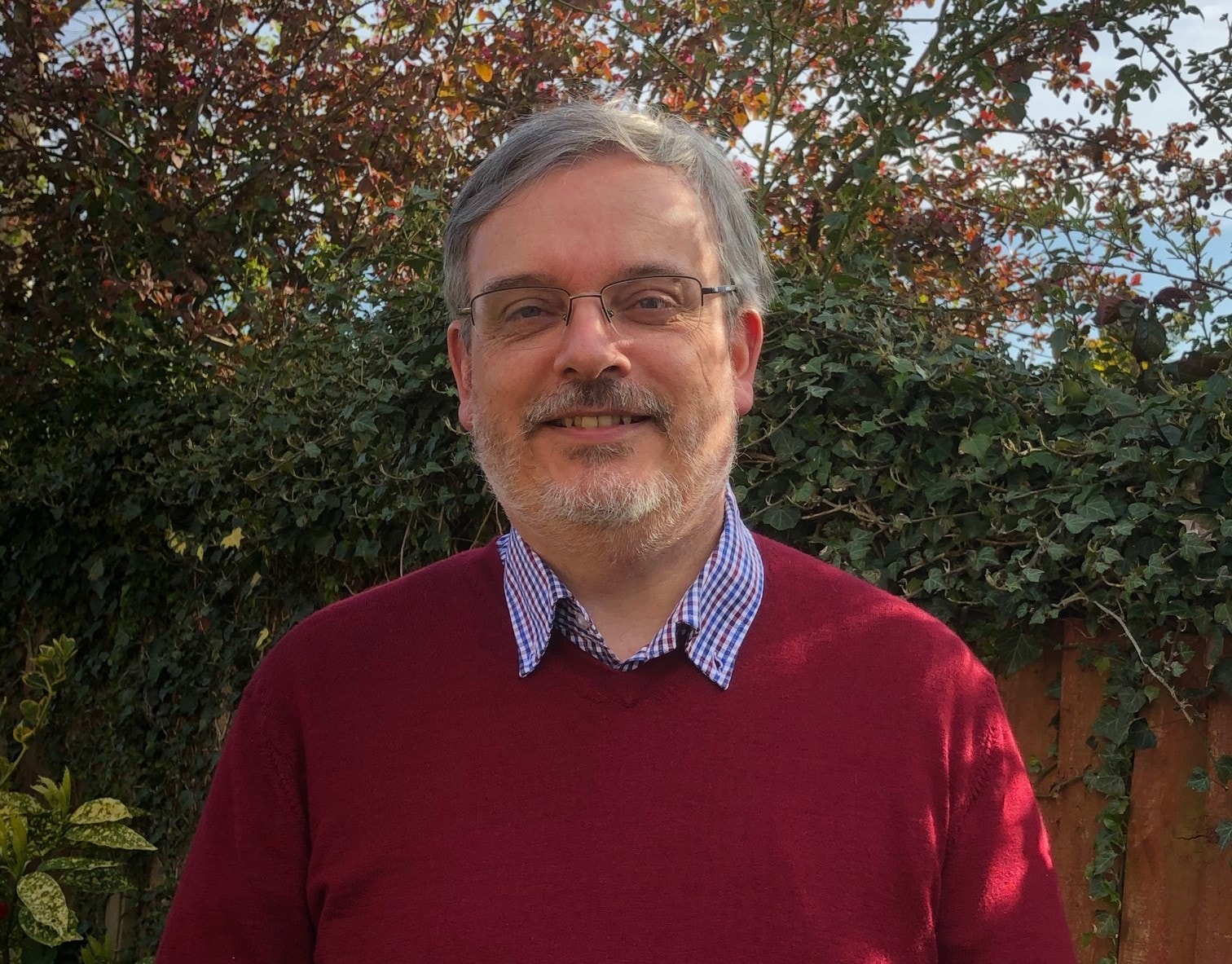
Professor Nigel Scrutton
Meet the researcher
Discuss this research with Professor Nigel Scrutton.