For the past two decades, the Manchester Access Programme (MAP) has been helping talented young people from underrepresented backgrounds access higher education, unlock their potential and shape their futures.
When Aminah Tehseen started to think seriously about university, she wasn’t sure it would be within her reach.
As a student with ADHD attending a state school that performed below the national average, and with few role models in higher education around her, formal education seemed difficult to navigate.
Yet today she is studying Medicine at Manchester – something difficult to imagine without MAP. “MAP gave me the confidence to put myself forward and to step into spaces that can initially feel quite unfamiliar,” she says. “It helped me realise I didn’t need to change who I was to succeed, I just needed to back myself in those environments.”
Alongside the confidence she gained, Aminah also formed friendships through MAP that would leave a lasting impact on her life.
This year marks the 20th anniversary of MAP, one of the first widening access programmes of its kind and one that has grown from 100 students during its launch year to approximately 750 today. Since 2006, it has supported more than 8,500 young people facing barriers to higher education, helping them build the confidence and skills they need to prepare for university life – with 3,300 going on to study at Manchester.
20 years of commitment
It helped me realise I didn’t need to change who I was to succeed, I just needed to back myself.
Young people from low-income backgrounds, or who encounter other barriers to education, are still significantly underrepresented across UK universities. MAP reflects the University’s longstanding commitment to ensuring higher education is accessible to young people from all backgrounds.
The programme works primarily with Year 12 students across Greater Manchester, from groups traditionally underrepresented in higher education, or facing socio-economic barriers that can make it difficult to access the same educational opportunities as more privileged peers.
Through workshops, events and an academic assignment, students develop a portfolio that prepares them for higher education, building key skills and confidence.
In addition to practicing academic writing, learning about referencing and receiving advice on their personal statements, participants also have opportunities to meet and learn from their peers, including campus visits led by former MAP students at Manchester.
A further key element of the programme’s success is contextual admissions, allowing eligible students a two-grade reduction in entry requirements. Gemma Oakes, Student Access, Success and Development Officer, says: “The University of Manchester launched MAP long before contextual admissions became common practice, and before widening participation was something universities were required to evidence. This programme has set the foundations for an institutional commitment to our civic responsibility to widening access to higher education for young people across Greater Manchester.”
Julian Skyrme, Director of Social Responsibility and the previous Head of Student Success, notes: “With tuition fees rising and financial barriers to university education increasing, we recognised the difficult reality talented students from less advantaged backgrounds faced. In creating MAP, we wanted to help level the playing field and pioneer a civic commitment to the young people in our local communities.”

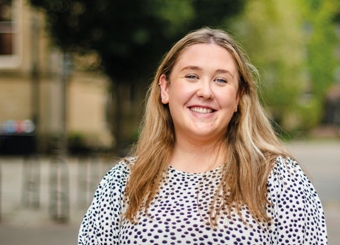
Aminah Tehseen, a Manchester Access Programme student, studying for her Medicine degree
To university, and beyond
Each student supported through MAP has a unique lived experience and faces different challenges. According to Gemma, the programme helps students navigate a huge number of barriers, from displacement due to conflict or experiences within local care authorities, to digital inequalities caused by low household income and limited access to information about higher education.
MAP focuses on working directly with students to make university feel less daunting and more like a place they belong, rather than somewhere reserved for a privileged few.
Before applying to university, Aminah worked as a surgical assistant in a cosmetic clinic and later at the General Medical Council, supporting patients through complaints processes. She says the confidence she gained through MAP has been one of the programme’s most important impacts.
“MAP has really shaped how I see myself and what I believe I’m capable of. That doesn’t stop at getting into medical school – it carries through to the kind of doctor I want to become.
“It’s given me a strong sense of perspective and purpose, and I think that will stay with me throughout my career. For me, being a good doctor isn’t just about academic ability – it’s about being able to listen, empathise and understand the communities you’re serving.
“Those are the values I’ve developed through this journey and they’re something I’ll carry forward in everything I do.”
Making Manchester possible
Last year, nearly a quarter of MAP participants went on to study at Manchester, with many more going on to secure a place at other universities. Those who successfully completed the programme were also eligible for the Undergraduate Access Scholarship, receiving £1,300 a year throughout their undergraduate studies.
Find out how you can support student inclusion and success at Manchester.