Alumna Rachel Yamin Thet reflects on how Manchester shaped her resolve to improve education for young people in Myanmar.
Rachel greets me for our interview – from her home more than 5,000 miles away in Myanmar – with a smile on her face that widens as she talks about her decision to study at The University of Manchester.
Rachel had considered both the UK and Australia for her studies, but ultimately chose the UK, having already completed a British Foundation programme at high school in Myanmar. We joke about the weather – Manchester’s cold and drizzle a stark contrast to home. Despite the frequent grey clouds, Rachel was drawn to the University, where she studied Management, by both its academic reputation and its social conscience.
The city itself had its own draw: “I love how vibrant Manchester is,” she says. “I really like that it’s such a diverse university.” She made friends from a wide range of backgrounds and soon felt part of a global community.
My time at Manchester... gave me the confidence to speak up, take initiative and believe that, even as a student, I could create something big and meaningful.
A formative time
It was in 2021, while in her first year at university, that a military coup in Myanmar, which disrupted or curtailed the education of many young people in her home country, compelled Rachel to act.
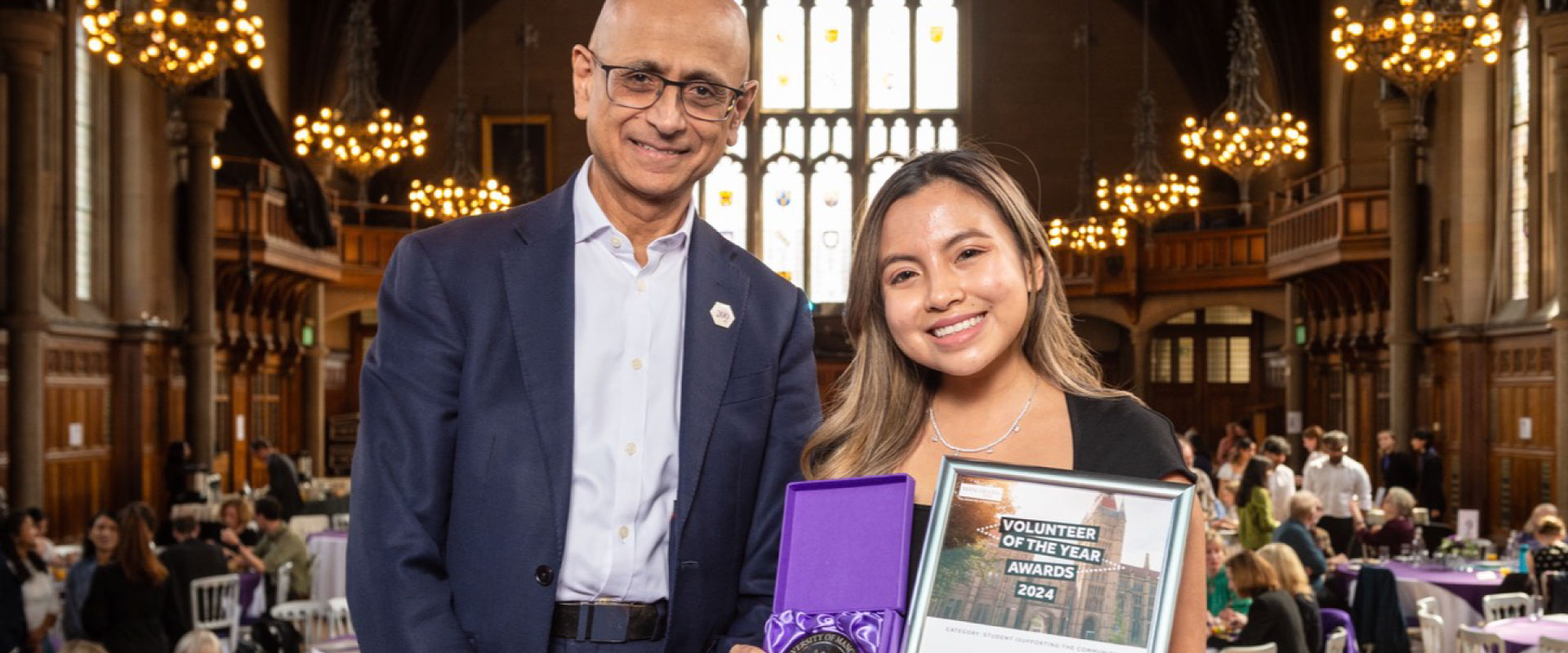
She co-founded Smart Start, a youth-led not-for-profit that works with volunteers and donors to provide young people in Myanmar with access to education. Smart Start would go on to win Rachel Manchester’s Volunteer of the Year Award. “My time at Manchester shaped me a lot,” she says. “I think one of the biggest things that it gave me was confidence. The confidence to speak up, take initiative and believe that, even as a student, I could create something big and meaningful."
Rachel’s voluntary efforts have certainly been both big and meaningful, turning ideas into impact. To date, Smart Start has helped thousands of young people in Myanmar access education and career support. She has since become a public speaker, a project planner and, most recently, launched her own scholarship programme in Myanmar.
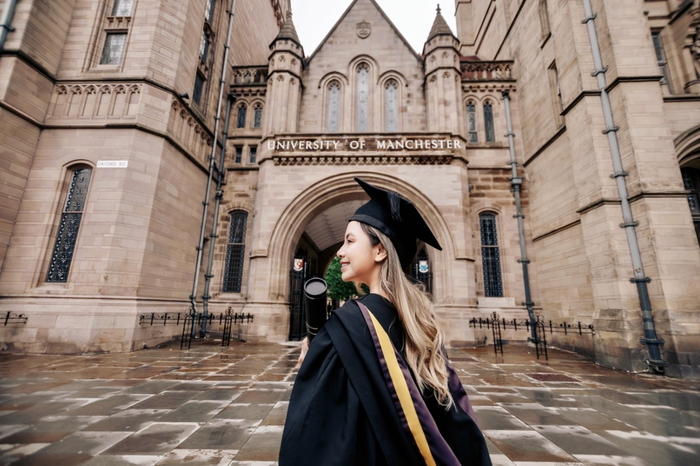
Rachel on graduation day
Her time at Manchester also gave her practical skills such as communication, leadership and strategic thinking. Rachel joined events organised by the Entrepreneurship Centre, meeting start up and social enterprise founders. “That really expanded my network,” she says.
It was a formative experience for Rachel, who reflects that she grew as a person as well as professionally. “Those three years have been, so far, the best of my life.”
From education to global action
Behind the scenes of Smart Start’s education and training programmes, which include online courses, workshops and mentoring, there is work being done to understand the challenges faced by Myanmar’s young people. Conversations, surveys and research are supported by volunteers and donors who help shape the programmes.
“We try to prioritise how we can make their lives easier,” Rachel says. Once the team has a clearer understanding of these challenges, they create programmes that ensure young people gain the skills they need to succeed.
Rachel recalls a particularly moving story from one of the participants. The student, who was living in an area affected by active combat, sent Rachel a message after an online event. She told Rachel how helpless she had been feeling, but that the support she received from Smart Start gave her a sense of “hope and encouragement”.
Hearing this is also encouraging for Rachel: “It’s easy to measure impact with numbers,” she says, “But it’s much harder to measure how meaningful things are for participants."
In 2024, using the prize money from her Volunteer of the Year Award, as well as her own savings, she launched an online scholarship programme for 80 students in collaboration with a private university in Myanmar.
This means that students living with day-to-day political instability can still continue their education. Rachel describes it as an opportunity that might not have been in reach for some young people previously.
When I ask her how the students are getting on, Rachel grins. About 80% of students from the 2024 scholarship programme have now graduated and gone on to enter the job market or continue their studies in Malaysia and Thailand.
Addressing global inequalities
All of this is not without its challenges. “Even when I launched the scholarship,” Rachel says, “I could see that the participation was uneven."
Students from marginalised backgrounds or more rural areas don’t always have the confidence to apply, even when opportunities are available. Access is also a barrier – some students struggle to join courses due to a lack of internet access, prompting Rachel to think about how programmes can be distributed in a more offline capacity. She’s learned a lot, she says, about how she might design the programmes in the future – “to reach people from every corner of the country.”
Looking ahead
The challenges and learnings from the launch of the scholarship will drive Rachel’s master’s research – she plans to learn about tools, design and methods that can be implemented to make future programmes more inclusive and impactful.
What stands out is Rachel’s focus on making young people’s lives easier. At a time when conflict has made growing up in Myanmar exceptionally difficult, her drive to keep education within reach speaks to her sense of social responsibility – shaped at Manchester and carried forward through the support of a wider global community.
Alumni like Rachel are sharing their skills, expertise and time, find out how you can get involved.